This post is part 2 of a series on dialogue. Click here to read the first post in the series about the three core forms of dialogue. This week's post on Words Like Trees pushes forward into the world of dialogue. We'll look at a concern that often arises with this fickle structure: is the... Continue Reading →
Literature and political commentary: how far from reality can we stray?
The other night, I finished reading Ariel Dorfman's play Death and the Maiden, a haunting examination of Chile's reckoning with the aftermath of dictatorship. The play itself was emotionally powerful, concentrated in its characters and ideas (somewhat in the way poetry has a density of meaning, like the brief but all-consuming burst from a candy... Continue Reading →
Worldbuilding #2: into the story we go
This post is part two of two in a series on worldbuilding. To read part one, click here. Last week, we explored how to plan and develop a speculative world, how we must situate ourselves along a continuum between the real and the absurd, how we can tie into existing cultural concepts while still making... Continue Reading →
Worldbuilding #1: setting fits the story
The worlds we construct inside our stories, especially in speculative genres, carry our readers to new possibilities, new ways of thinking about life and what is set and normal. Worldbuilding is one of the great excitements of the writing process, as our minds, omnipotent in the world of the story, trace out societies and structures... Continue Reading →
Why speculative fiction compels us: place, time, and the imagination
Near the end of my journey north, the bus drove onto a ferry crossing the Sogn Fjord. I disembarked and went to the boat's edge. Beneath me, the motor sounded deep and long, like a brilliant foghorn sweeping out over the water. Mountains jutted up on either side of the fjord, and swirls of gray... Continue Reading →
Character development: the bubble model
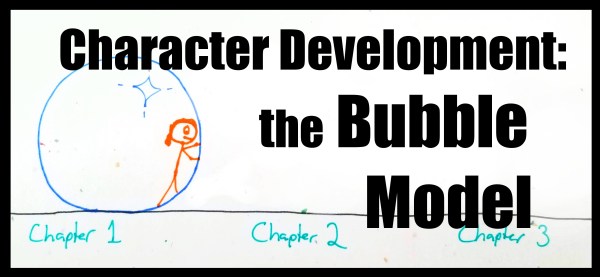
The lifeblood of so many stories is in their characters. An unsympathetic, unrelatable protagonist can easily drive readers away, and writing believable, sympathetic characters can pose real challenges. Not least among these is the question of how our characters change from beginning to end. How do we write believable, authentic change in our characters? How,... Continue Reading →
Revising for consistency: the case of the mysteriously changing hair color
I think both look pretty nice. Why must I choose? A novel is big, literally as well as temporally. At the point I finished a complete first draft of my novel, I had an embarrassing splat of 160 thousand words and a nearly three-year distance from my first paragraphs. Revision beckoned; then it loomed. Although... Continue Reading →