Today’s post moves away a bit from writing. I apologize, even as I violate key blogger advice of “sticking to one’s niche.” In truth, this post is about what has been making it hard for me to do much writing recently, committed as I remain. Readers, I thank you for sticking with me. I can say only that I am a person first, a writer second. If you’re here for the writing advice, then I beg you to wait a week. If you’re here for meandering thoughts, I hope you’ll read below.
We completed the week’s classes in a blaze. October Grades, the ones that will be sent to universities, are coming due, and the teachers are flurrying to generate enough data with which to make them true. The students, accordingly, are busier than I have ever seen them, and it is in melancholy that I watch them struggle, advising when I can, helping them prioritize, I hope building their resilience, but goodness, I know that they are overburdened.
I remember my own tears at their age. I was sitting with my sister, telling her everything I had to do as I clutched my European History textbook, and I started crying all over the Partition of Poland. Now, older, the beneficiary of that education that pushed me hard but undoubtedly propelled me to the opportunities I’ve had then since, I wonder what the right answer is. Of course young people need to learn resilience. We need to learn to do things we don’t enjoy. We need to learn to make difficult choices. Those skills, perhaps more so than the explicit knowledge gained, they help us in the years ahead. At least that’s what I tell myself when I assign those essays, when I explain the marking criteria, when I hand out another quiz. This is part of the process, I tell myself, and in the end it is for the good.
When I taught in the United States, I determined the final grade. I set the assessments, the essays, and the tests. Continuous Assessment is the model we follow there, and it is at great odds with much of the rest of the world, whose teachers instead prepare students for examination by an external body–a national exam board or, in the case of the school I teach at now, the International Baccalaureate.
Sometimes, with my advisees, with the knitting group I led last year, we circle the room with Rose, Bud, and Thorn. It’s a check-in, me checking up on them, but also the opportunity for the students to share with one another and build community among them–rose: something good that’s happened recently; thorn: something not so good. The bud is something they are looking forward to. I used to tell students they couldn’t say “the weekend.” Then I let it go.
I share too, and often my thorn is, “I’m behind in my grading. I’m swamped.” And when I say this, invariably students will grin a little bit, cast a sideways eye at one another, then at me, and one will say, “Maybe you shouldn’t assign so much work!” I laugh, I throw up my hands in some kind of defense or plea for mercy or a prayer–“But how would you learn if I didn’t?”–that’s what I would say in the US. Here, I ruefully can add, “What would the IB say?” They laugh with me, and we move on.
But it is a strange thing, after all. To avoid the bigger, more consequential pain of a low grade, we dole out bits of pain in the forms of practice essays and impending tests. “Here’s your daily morsel of stress,” we say. “It’s good for you!” We grin. And I suppose it is, to a point.
I sit on the school’s Academic Committee, where administration, teachers, and Student Council representatives meet monthly for discussions. Last Monday, it was this issue, this stress, perhaps undue, and perhaps not. A colleague who has been teaching for much longer than I argued that at fault is not the demands of the educational model, but current cultural ideas of stress. The demands placed on students are the same, he said, but the response which used to be, “I have a lot to do” has now become, “I’m drowning.”
I am curious about this idea, how our thinking drives our response to busy times. I’m sure that it does. I’m sure that, and I cite ideas of Cognitive Behavioral Therapy here, that if the way an individual person can think about traumatic experiences in their life can influence the effect of that experience on them today, of course the way we think could influence our perceptions of stress.
Of course, saying this and making a change to long-rooted, culturally-conditioned thought patterns are hugely different. And it also does not at all mean that the education system is not at fault. Perhaps it is today’s response (“I’m drowning!”) that is more appropriate to the behemoth we foist daily on our students. I’m not yet sure.
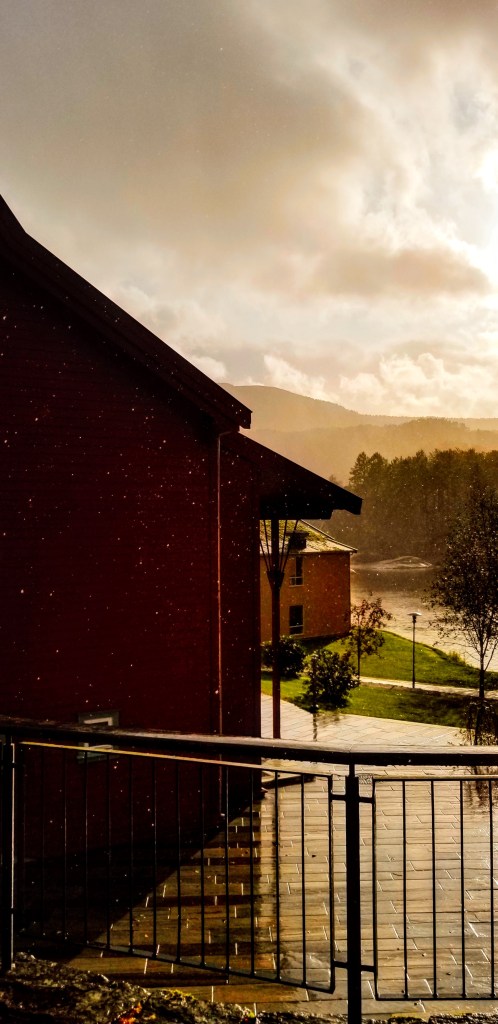
I am still busy. This coming week, I will grade essay upon essay. I will calculate October Grades. I will also be leading with my husband a weeklong workshop with eight students on Slow Food. We’ll be milling grain, making cheese, fermenting sauerkraut, kimchi, and lemons, nixtamalizing corn to make tortillas, and baking bread. Each student will present about a traditional food from their home. I’ll do my presentation about pumpkin pie. And it will be great, I am sure, as well as busy. A week’s break from regular classes. Experiential learning. I’m looking forward to it.
Maybe, in the afternoons, I’ll have some time to write. We’ll see. At the moment, though, I’m worn a bit thin. I too am feeling stress, although maybe I should be saying instead, “I’ve got a lot to do.”
Best wishes to you, and thanks for stopping by.
With love,
Jimmy


When I feel overwhelmed, I try to remember the joke about how you eat an elephant. One bite at a time.
LikeLike