My biggest questions about stories the last few years have been focused on structure. What is the role of conflict? Do all stories really follow the same dramatic structures, or is this an oversimplification? What alternative story structures might exist (such as Kishลtenketsu), and how do they function in different cultural contexts? When I asked... Continue Reading →
How Real is Real Enough?
I notice a fixation when I write on, let's call it, "textbook plausibility." It's always fiction, but I take great pains to make things possible. This could really happen, I hope the reader feels. Although we both know it never did. I'm currently working on a new story that I'm envisioning in a very specific... Continue Reading →
The Joys of Simple Writing Prompts–#AuthorToolboxBlogHop
This week's post forms part of the monthly Author Toolbox Blog Hop, in which writers at all stages of their careers come together to share knowledge. It's a good group. Check out the posts of others here. In this second week of school this year, our student creative writing group commenced. Two budding student leaders... Continue Reading →
Scene and Summary: Recasting the Balance–#AuthorToolboxBlogHop
This week's post is part of the monthly Author Toolbox Blog Hop. Check out posts by other writers about writing craft and industry. It is a good community and a good resource. #AuthorToolboxBlogHop The longer I poke at things I long believed about writing, the more they crumble like a log long on the fire.... Continue Reading →
Perfect Contradiction: a few gems from Alan Hollinghurst’s “The Line of Beauty”
Last week, I began reading Alan Hollinghurst's The Line of Beauty, a brilliant tour of Thatcher-era upperclass London, narrated in close third-person focus on unabashed gay hedonist Nick Guest. Although the window into Nick's world is undoubtedly fascinating, it is Hollinghurst's writing that I have been most entranced by. And that's what I'd like to... Continue Reading →
Synecdoche & Metonymy: Figurative Language Bootcamp #3
This post is third in a series about figurative language. The first post in the series discussed simile, metaphor, and symbolism. Last week, we explored personification and zoomorphism. Today, we will drive on to the realm of some lesser-known cousins, synecdoche and metonymy. Synecdoche A subset of metaphor, synecdoche refers to a part of an... Continue Reading →
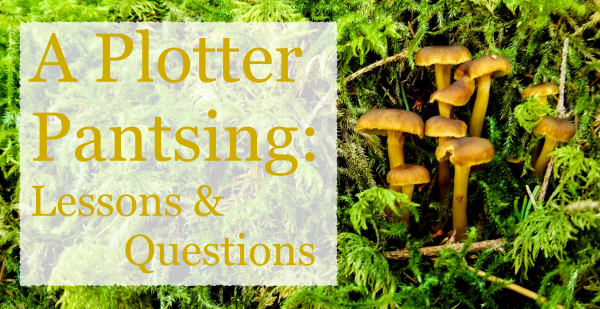
A Plotter Pantsing: what I’ve learned, and what I’m still trying to figure out
In Twitter's #WritingCommunity, the discussion of plotting and pantsing our stories is a common thread. Plotting, the careful outlining of a story before writing, and pantsing, the seat-of-our-pants, unplanned, accepting-what-comes creation of a story, each draws a crowd of strong adherents. Out foraging for mushrooms this week, we came across this beautiful chanterelle, late for... Continue Reading →
Revising for consistency: the case of the mysteriously changing hair color
I think both look pretty nice. Why must I choose? A novel is big, literally as well as temporally. At the point I finished a complete first draft of my novel, I had an embarrassing splat of 160 thousand words and a nearly three-year distance from my first paragraphs. Revision beckoned; then it loomed. Although... Continue Reading →