One of the things I love about teaching literature is the way its central questions push my thinking. Usually teacher-Jimmy and writer-Jimmy inhabit distinct mental spaces, but sometimes the two dovetail alongside. With the start of the new school year, meeting new students, lesson planning, checking how advisees are settling in, I got to have... Continue Reading →
Continued reflections on conflict and story structure
Some stories seem to move more slowly than drying paint. They elongate scene after scene of a bland character sitting, contemplating, staring at walls. Whole novels can go by without the character doing much more than taking a sip of their watered-down beer as they contemplate the vagaries of their universes. How often do I... Continue Reading →
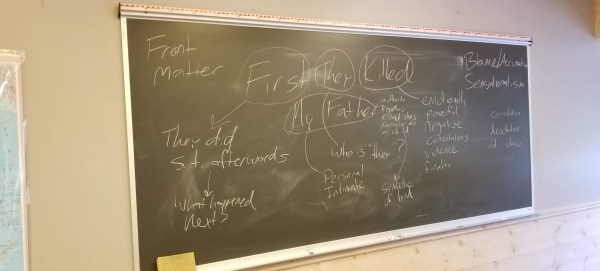
What’s in a title?: examining the title of First They Killed My Father
Content warning: this post contains discussion of genocide and associated acts of violence, in the context of a literary analysis. The week has been packed. On Tuesday and Wednesday, I led student orientation workshops on diversity, introducing ideas of social identities, individual differences, and how assumptions arise when we meet people different from ourselves. The... Continue Reading →
Can reading literature change our beliefs?
I remember a fable I heard once, from some origin that I can no longer locate. I think I was told this story by a speaking voice, perhaps by a teacher at school, perhaps elsewhere. The situation of its telling has thus vanished, but I remember the story perfectly. Let me share it with you... Continue Reading →
The Reading Sickness
My husband is not a reader. While I wade up to my eyes through stories, he stays dry. We are different people, and that is fine, but I have wondered for years precisely why he doesn't love to read--to me it seems so natural. To me, it is necessary. He has told me sometimes, that... Continue Reading →
Philosophy in Fiction
My junior year of high school, I took an elective English class entitled Philosophy in Literature. We thirty teenagers and one brilliant, grandfatherly teacher crowded into that classroom to sift our way from Bishop Berkeley to Plato's Cave, Bertrand Russell to Kierkegaard to Kant's Categorical Imperative. All of these thinkers were brand new to me,... Continue Reading →
Apparently, I’m Blogging All Wrong!
This week, let's look at blogs. What make one tick and another flop? Why do some get clicks and others languish patiently? And which is this? The IB syllabus for my English language acquisition students asks them to practice writing a variety of text types, from letters to proposals, from persuasive speeches to brochures. This... Continue Reading →
Short Story and Novel: Key Differences in Form–#AuthorToolboxBlogHop
This week's post is part of the monthly Author Toolbox Blog Hop. Check out others' great posts about the craft and business of writing! I first encountered Haruki Murakami through his short story collection The Elephant Vanishes. These stories of middle-class life in Japan were bizarre, esoteric, often difficult to get my mind around. The... Continue Reading →
My First Publication!
A week ago, just as I was finalizing last week's blog post, I received an email letting me know that a magazine wanted to publish a short piece I had submitted to them. Oh? They do? Oh! Oh my. My that feels good. It has taken me some time, some grief, and lots of effort.... Continue Reading →
Mode, Genre, and Form: Three Ways to Think More Deeply about Our Texts
In the huge range of texts we write, distinguishing among them helps us know what we are writing, helps readers know what to expect, and helps us connect our pieces to readers who will enjoy them. Today we'll discuss three central ways texts are distinguished from one another: mode, genre, and form. These tools help... Continue Reading →