There are few films (and I find it a bit ironic that it is the film we go to before the book here) more called upon for inspiring young writers than Dead Poets Society, in which charismatic literature teacher Mr. Keating (Robin Williams) leads a group of teenage boys to discover their personal voices. In their dogmatic, regimented, ivied prep-school, Keating challenges the boys to think freely, to challenge the established order, to “sound [their] barbaric yawp over the rooftops of the world.”
In one of the (many) iconic scenes of the film, Keating asks students to stand on top of his desk so that they might see the world in a different way. In this early lesson, the students, nonplussed, go through the motions. It is only later that they understand the import of the exercise.
It was perhaps funny, after having known the film for years, having read the book and adopted it as catechism, to have it brought back to me in an Educational Studies course in college as an example of a teacher overstepping boundaries in the classroom. Our professor assigned the film (along with another classic education film: Freedom Writers) and we came in on Monday excited by the world-changing work these teachers were doing for their students. Instead, our professor’s perspective was the opposite, that Keating and Gruwell had indeed changed lives, but for Gruwell it came at the unacceptable cost of her own wellbeing and family, and for Keating, well, I will not give a spoiler, but the cost here is far higher. And though we idealists would like to praise their efforts, in that lesson I was duly chastened. What is more, although perhaps innocuous for its time, Dead Poets Society uncomfortably reinforces patriarchal values and has no representation of people of color. Does it deserve its canonical place? It’s not a simple answer. We must look at things in different ways to understand them.
This month, my friend Kate and I are recommencing our annual tradition of New Things Month. Each year we plan a list of thirty tasks, which must all be new to both of us. We assign these each a day in April (this year March; let’s be new, after all!) and work our way through a month of new experiences.
Today’s New Thing was to write a new kind of poem. And so I went to work. Some short research. Nothing grand. In truth, I wanted to be done quickly. I’m nearing the end of a week’s break from work, and the essays to grade are piling up.
I settled on sedoka poetry, an old form, my research said, composed of two tercets, each following a 5-7-7 syllable-per-line structure. This seemed simple enough. But what caught my attention was the relationship between the two stanzas. They both might portray a scene (often nature-based) but might examine it from two differing perspectives. This felt like a good exercise for me.
I was surprised by how much I enjoyed writing the sedoka. I wrote two of them, and in both poems my original perspective on a thing was challenged, necessarily, by myself, the simple dictates of the form, by my own writing.
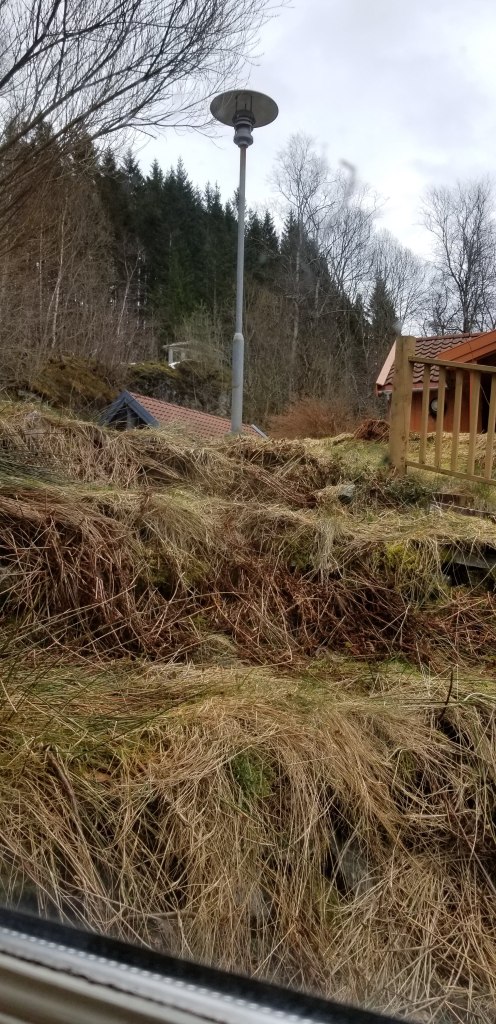
I looked out the window. It was brown, gray, dreary, and no doubt imbued with the impending drudge of those many essays. I scrawled this down:
Brown grass tamped down from
Snow now melted blows dry wind,
Breaks across the piling stones.
But then it was time for the second stanza. And what other perspective could I bring to that so awful grass? It was more difficult than I expected. I felt the machinery of my brain rusted down immobile. Inwardly I groaned. Eventually I wrote,
Bedded grass, wise, bent
Down, shields new growth in sprouthood,
Unselfish part of the whole.
Forgive me for being a little sappy. No. Don’t forgive me. Let me embrace it. It’s a good antidote to a gray day. The poem, an exercise in reframing the mind, had done its work. I was pleased.
The first poem had followed a simple structure:
- Stanza 1: bad
- Stanza 2: good
For the second, I wanted two less diametrically opposed but still distinct perspectives. I scanned around for the object of my study. I settled on the lamp’s reflection in the window, just visible in this picture, right before my eyes:
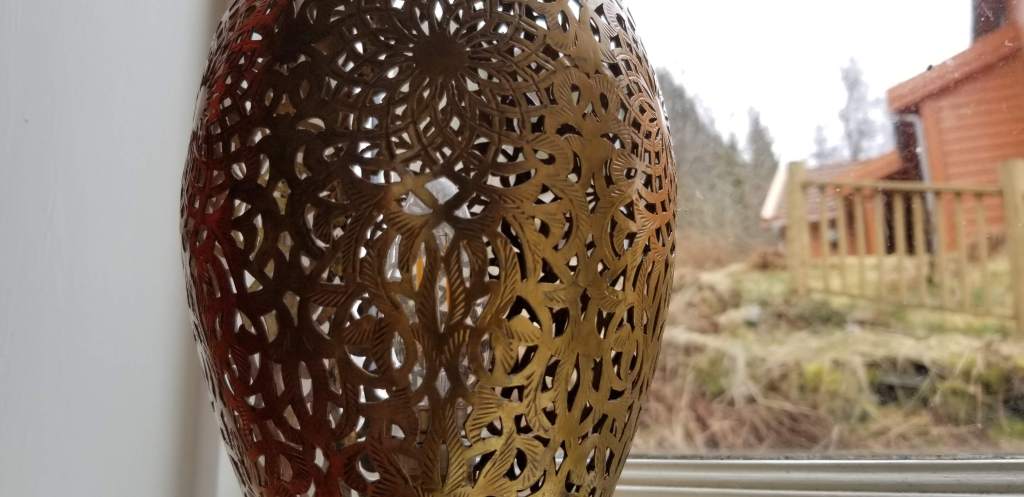
Here’s the poem:
The window-glass casts
Back an image of this lamp
Half-forming ghost mirror light—

Superimposing
These brass cutouts on the spring
Morning in my mind—so long.
In stanza one, the focus is on the reflection for itself; in the second, its relationship to other things. And you know what? I had never thought of that before. It’s not earth-shattering. But it is new. It is a kernel of beauty I had not before seen. The requirement of the poetic form pushed me to those thoughts, and I am grateful.
Writing is a kind of meditation, I believe. It is a patient looking, the careful awareness of the world, a reluctance to form conclusions hastily, a willingness to see one’s original perspective changed, as much from within as from outside. As a reader, how often do I step back from a page saying, “Wow. I’d never thought of it that way.” I suppose it goes the other way too. We write. Until we’d written it, we’d never thought of it that way.
Best wishes, happy writing.
With love,
Jimmy


Wonderful post! Thanks for the new-to-me poetry form. I love what you did with it!
LikeLike