They say the best way to learn a thing is to teach it, and in the trial by fire that is the teaching of a new syllabus, I have been learning a lot this week about the literary essay. I am looking explicitly at the theory now of a genre I have long read, enjoyed, and also written. These students demand depth and rigor, and I am doing my best to provide such. I’m growing as a writer along the way

Essays seem to exist everywhere and nowhere, and are accordingly one of the more slippery genres on the table. An essay is a short, nonfiction work that presents an author’s perspective on a topic. Fine. Simple enough. So is this blog post an essay? No, it’s a blog post. Or yes, it is any essay posted on a blog. And how about this opinion column in the newspaper? Same deal. The essay’s tendrils stretch from the dedicated anthology or collection, to magazines, to blogs, to newspapers, to social media posts. Essays so often go by other names, and yet their cores are not at all so different. Sometimes I think the term essay is more a sign of prestige (or else attempt to lend prestige) to some thoughtfully-crafted short piece of nonfiction. But if Words Like Trees gets called a trove of essays, I will not mind.
I wanted to give my students some of the structure they are always craving and which I often find myself struggling to provide, because of how free and loose and ever-changing this field of textual analysis can be (its beauty and its unraveling, I’m sure). Wikipedia directed me to Aldous Huxley’s preface to his Collected Essays, in which the author proposes a straightforward but remarkably illuminating tool for thinking about these chimerical texts. These last days, my students have been using it to analyze some brilliant essays. It’s relevant for us too as writers.
Huxley’s three poles
Huxley (and yes, this is the same Huxley who penned that dystopian monstrosity that I can appreciate at least, if not like) proposes that the essay is best envisioned stretched between three poles: the personal-autobiographical, the concrete-objective, and the abstract-universal.
To gloss these in greater detail, we can say that the personal-autobiographical pole is the starting point of experience. The writer narrates anecdotes from their own life in a form not unlike fictional storytelling.
In the concrete-objective pole, the writer engages with existing human knowledge, describing the real, tangible world, trends in society, and discussions of real-world issues that affect people beyond the author alone.
The third pole, the abstract-universal, philosophizes about significance and meaning, universal truths and principles. Huxley paints a brief but comical picture of those essayists who concentrate their work here, who “hardly deign to take notice of the particular facts, from which their generalizations were originally drawn.”
How the poles function in an essay
While most essayists, Huxley argues, excel in one or perhaps two of the poles, the best essays navigate between the three with a dancer’s precision. They begin, perhaps, in the personal & autobiographical, spin outward to the objective, return to the personal, then shoot upward to the realm of the abstract.
We can visualize this movement with each pole at the corner of a triangle, where each of the black circles identifies a “stop” along the way within an essay.
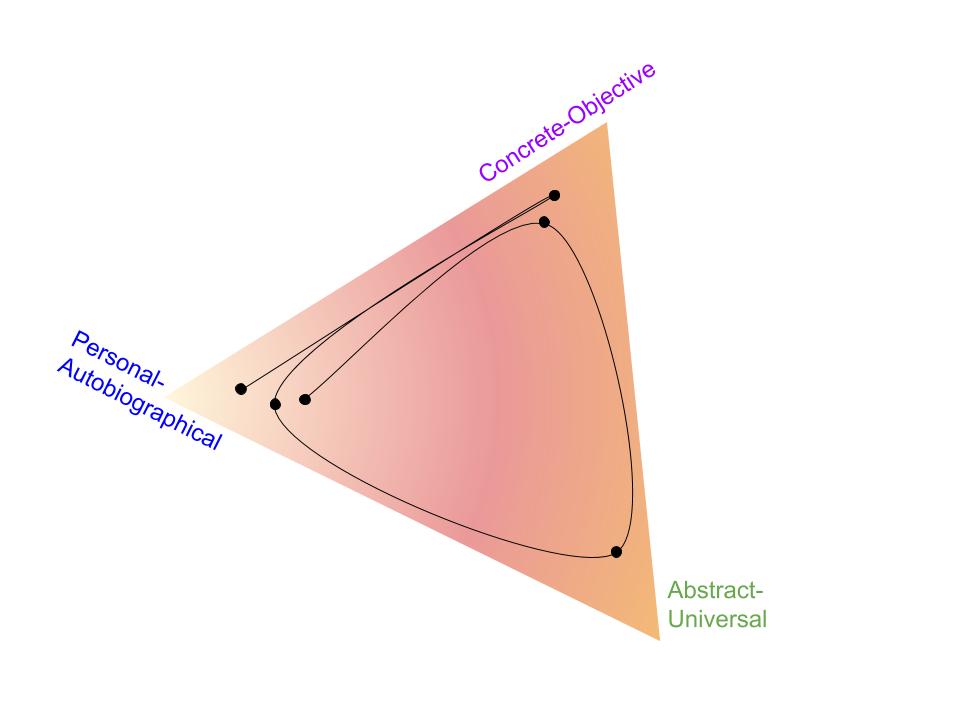
Huxley’s preface itself begins in the realms of human knowledge (that of the essay itself) but later grows personal as he waxes about his own essay career.
This simple model rapidly opens our understanding of structure and connections between ideas in the essay. The movement between the poles keeps the line of thought fresh, gains the intimacy of the personal narrative and also the broader relevance and depth of the other poles.
The relevance to writers
The applications for the essayist are quite clear: considering how these three poles might be useful in tracing our line of thought for an essay can help us build a structure that is intentional, engages readers, and stays true to our vision. The poles might be useful in analyzing a piece for revision, identifying areas where a shift in pole might strengthen the narrative, or where the essay is moving too quickly, disorienting readers.
The poles are useful for blogging too. A few weeks ago, I wrote about the way my research into blogging left me feeling lost, like what I am crafting here is not a blog at all. Some kind comments from readers buoyed me up, but learning about essays has helped me reorient what I’m doing. In fact, I see more similarity between the kinds of posts I often write and essays than I do to the more utilitarian-focused blog post.
I recognize that Words Like Trees is really a hodgepodge of text types, ranging from the more informational craft discussions to largely personal reflections on recent events. I’ve often questioned the place of the personal in blogging. Thinking of these posts as essays gives me a greater freedom and intentionality in my writing.
I am wondering about the potential relevance of this discussion for fiction. Of course most fiction would fall squarely within the realm of the personal (and sometime the autobiographical!). But even if it remains within the context of the story, fiction can often move to the abstract, reflecting on the deeper significance of elements of the tale told. I think too about some fiction that incorporates great amounts of scientific or sociological knowledge, sometimes laid out explicitly in the text, especially in older novels. I’m curious about how these poles might function more explicitly in fiction. I’m not sure.

Final thoughts
I’ve returned this week to a favorite book of essays, Let There Be Night, an anthology arguing in so many brilliant strands against the ever-burgeoning light pollution blinding our dark skies. I’ve picked out an essay to work through with my students next week. As I’ve been reading these diverse perspectives, I’ve been contemplating the three poles. It’s opened the essays up for me in a new way.
Huxley says that the essay, like the novel, is there for “saying almost everything about almost anything.” I feel lucky to be returning to these essays now, with their deep and careful thought, so soothing and necessary in these times, as perhaps always it has been.
Do you have favorite essays? What do you think of the relationship between the essay and the blog post and other genres? How else besides Huxley’s three poles might we usefully understand them?
Thanks for stopping by, and best wishes,
Jimmy


