We arrived back in Norway to an incredible winter pageant. A couple inches of snow was encrusted everywhere by the most overwhelming display of ice crystals I have ever seen. Half and inch to an inch long, flat and shiny, sparkling, brilliant blue, the whole world was growing these crystal shards somehow like metallic mushrooms, spilling like a crown of moss spills from a boulder.
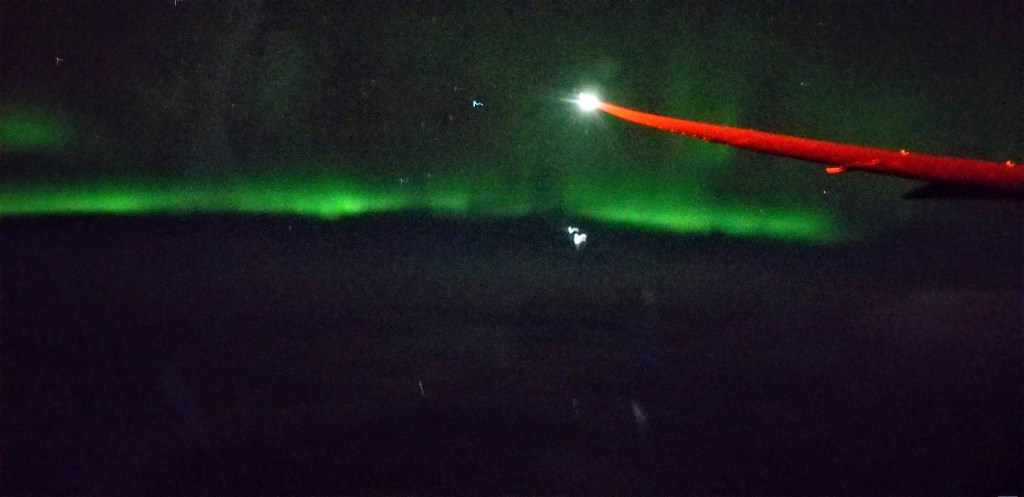
Things went smoothly after my last post. Our Covid tests came through on time and negative. We crossed the Atlantic in a nearly empty plane. We had chosen seats on the right side of the plane in the hopes of seeing the sunrise or the sunset (although we missed both; the entire flight took place in darkness), but when, crossing the Labrador Sea between Canada and Greenland, the pilot announced that the Northern Lights were visible on the left side of the plane, there was no one there. We crossed over the cabin to witness this display.
O’Hare airport was quiet and calm. Our flight from Amsterdam to Bergen, however, was packed, and the usual ease of exiting the airport in Norway was a mere memory: we stood in a cramped line of passport checks to register our intended quarantine destinations, completed mandated Covid tests again at baggage claim, even had a Customs check, which in four years here we had never before encountered.
We also arrived home to the terrible sight of people storming the US capitol. We could not believe it. Some trick of the jet-lag. I am praying that the result is at last an awakening to the dangers of this presidency. The terror of the tragedies that have befallen common people during this administration (children removed from their parents, far more Covid deaths than should have happened, police brutality) laid bare at the US Capitol with lawmakers having to hide under their desks. In this administration’s death throes, I would like to say we are getting better, although perhaps it’s only because it’s at the end, that institutions are finally taking stands. They want to be remembered as having taken action, though I wish they had done so far earlier. I am praying that the transition does in fact go peacefully.

And back to writing. It is a new year, after all, and as we enter the third year of Words like Trees, I’m ready to set some writing goals for the coming year.
What makes for a productive goal?
My experience with a word-count goal in November reaffirmed my belief in declaring a specific purpose as a way to motivate and direct action. We’re ten days into the new year now, but I don’t think it’s too late for a little goal-setting. A goal directs us on a road towards something. Just like in teaching we begin our lesson plans with learning objectives, then map out the path we will need to bring our students to that point, setting goalposts on our writing journey helps us take specific actions that will bring us where we want to be.
SMART Goals
The SMART acronym for goal setting has been around now for some time. I think it is useful, so let’s review it here. The most helpful goals are…
Specific: The goal points to a particular, narrow action rather than to something general.
Measurable: We can judge whether we have met the goal with an ideally quantifiable (or at least specific and clear) criterion.
Attainable: This goal is within our power to achieve: it’s doable and realistic. At the same time, I think a potential pitfall here is trying so hard to make the goal attainable that we in fact make it too easy. Yes, the goal needs to be attainable. But if there is no chance of not attaining it, is it really a goal? This attainable I think also requires an element of challenging.
Relevant: This goal is in line with our more general values and purposes.
Time-bound: We can put a time-limit on achieving the goal to keep a bit of a fire under our seats!

How to make a SMART goal
Of course the SMART acronym has to be given in the order listed above if it is to spell something memorable, but thinking about these attributes in a different order is more useful for actually developing the goals. Here’s how I make sense of them:
Start with “Relevant”–big picture, what general intention am I working towards?
For me, I’m hoping to use this year to continue to build my writing career, improving as a writer but also increasing my publications, gaining readership, finding homes for the things I have written already. I know I want to produce more work, and I want to find avenues for that work to be read.
Next, consider “Measurable”–what specific data can I use to measure this more esoteric intention?
The modern world of education loves data, so I am used to thinking about different ways to measure abstract things. This can apply to writing too. A few quantifiable measurements we can take of our writing could include…
- Measurements of writing itself
- Word count per day, per month, or over the year
- Daily time devoted to writing
- Number of stories/chapters/pages/blog posts written
- Measurements of publication
- Number of publications
- Number of submissions of queries sent out
- Measurements of readership
- Number of views on a particular post or page
- Circulation size of publications in print magazines
- Number of book sales or downloads (I don’t have books on Amazon or other online platforms, but for many indie writers, this is a key measurement!)
- Number of newsletter subscribers
- Measurements of community-building
- Numbers of likes or comments on a blog
- Number of Twitter followers or interactions
What other measurements am I not thinking of? Let me know your ideas in the comments below!

Use a selection of these measurements to set specific goals
Choose measurements that line up with your overall intentions. For me, I’ve chosen to focus on word count, number of submissions, and number of publications. Although I definitely intend to continue my minimum-one-hour-per-day writing habit (and I’ll have to if I am going to achieve the goals I’m setting for myself!), I’m not setting a new goal related to time specifically.
For each measurement, we have to determine the number we are shooting for, and here is where that “attainable” but with that element of “challenge” that I mentioned above comes in. We want a number that will push us to grow but that is also doable. Here we need to listen to ourselves.
A year ago, I had no publications. I don’t think I would have had the stomach to set a goal of number of publications for myself. But today, I feel more confident. I think I can set a modest publication goal. I don’t know if I will meet it, and that is where the challenge comes, but I will try.
We also need to place time markers on our goals. This is not a question of “if I don’t achieve the goal by this date I have failed”; rather, the time-marker keeps us motivated. It is a deadline. Of course if we achieve the goal after the time limit, we still win, but we want to minimize our opportunities here to procrastinate.

Jimmy’s 2021 Writing Goals
Okay, here they are. I have to say, I feel a tad vulnerable putting these out here, but it is good for me. Let’s see what I can accomplish!
Word Count
During November 2020, the only month for which I actually measured my word count, I wrote 14,097 words. Of course, that was in a period of heavy drafting, and sometimes my focus is more on editing. I’m not entirely sure how to navigate this one, but I think setting a more modest word count goal could help push me while also acknowledging that I am not always drafting.
I don’t ultimately want to set a measurement on editing and revision, at least not yet, because these things are so variable in terms of the time required. Therefore, we’ll stick to the drafting goal and see how it goes this year.
I will draft at least 7,000 words per month, January-December of 2021 (for a yearly total of... oh gosh this looks like a big number... 84,000 (eek!)).
Publishing
During 2020, I found homes for three stories in literary magazines, and I want to keep that up. This goal is my real unknown, because it’s ultimately up to the decisions of editors. However, I’m prepared to take the risk. It’s a sign to myself that I believe I can do it. I won’t set my sights too high, but I’ll try to keep going at the same rate this year. Who knows–maybe I’ll end up doing better than I think. My goal:
By the end of 2021, I will place three more stories in literary magazines.
During 2020, I sent out 155 submissions and queries. To increase that, I’ll set the following goal:
Each month of 2021, I will send out at least 16 submissions or queries (for a yearly total of at least 192).

Keeping track and keeping accountable
To hold ourselves to our goals, we need to keep our measurements. I have a good system for keeping track of submissions and queries, but outside of the NaNoWriMo website, which I don’t think (though I could be wrong) is active month to month, I don’t have a system for keeping track of daily word counts. I’ll put a quick spreadsheet together for that.
I haven’t decided yet whether I’ll include blog posts in my word count. It’s a different kind of writing from the fiction that I am ultimately focused on, yet it is of course writing, and it is a meaningful part of my journey. I’ll see. Maybe if I’m short on words one month… but no. I want to be serious about these goals. It is a serious venture.
Conclusion
I hope these goals will help me move. I can already feel the mountain of them, and I think that is good. If we want to continue growing as writers, we need to push ourselves.
What goals do you have for 2021? What are you planning to achieve?
School begins this week, virtual at first, while the students and many of we teachers quarantine. I am hoping for a good term ahead.
Best wishes to you all, and thank you for reading,
Jimmy



 Jimmy Kindree
Jimmy, I am impressed with how hard you are working on your goal of writing and publishing. You are dedicated and organized. I think you will have some real accomplishments this year!
LikeLike