Over these last couple of years, I have learned the power of goal setting to push my writing forward. In 2021, I set goals for monthly word count, submissions, and publications, and as I could have foreseen, met only the two goals I had meaningful control over. That was a good lesson learned. In 2022, I’ve upped my goals and also thought more carefully about what goals will do to me in terms of motivation and focus. Two months in, it’s time I think to make an update. Let’s see how things are progressing.
Using goals for encouragement instead of guilt
Goals can be powerful motivators, but they also have a potential to have negative emotional impacts, particularly when we don’t meet them or when we worry we won’t. When we initially set a goal, we might feel full of determination, hope, and pride. Later on, during the slog of hard work, that same goal can feel like an impossibly far finish line. It can be challenging to avoid laying over oneself a feeling of guilt. You have to meet it, I sometimes find myself saying. You made a promise to yourself.
When I work on goal-setting with students, I try my best to preempt self-shaming. We talk about how, if we set a daily study goal, for example, it’s almost certain that we won’t meet it every day. And that has to be okay. That’s normal and human. And the worst thing that can happen is that, when we fail to meet the goal that day, we give up entirely. We say, “Well, it was always going to be impossible,” or “I’m just lousy at meeting my goals.”
Instead, we should affirm ourselves: “It’s fine not to meet my goal every day. I really needed to rest today, or I had other things that came up.” Tomorrow, then, we try again. We try to keep that open, affirming attitude, to keep the goal not a tool for shame, but a tool for striving towards.
In my own work, I recognize that it is often difficult to maintain that positive focus. In the first two months of the year, I often found myself chastising myself. The clearer it became that I would not meet my goal for writing new short stories, I felt sad.
My personal work, then, became about working through that feeling of guilt and releasing it, letting myself just sit in where I was and then moving forward. It’s okay. It’s true, I did not meet that goal for two new short stories, but I did write one. That’s almost certainly one more than I would have written without that goal. That is a victory.
Daily writing time
I increased my goal for daily writing time this year, from 55 to 85 minutes. I also tracked it specifically, which I was not doing in 2021. This is my “flagship goal,” the one that sets me up to meet any of the others, and it’s the one I feel the most excited about this year, as evidenced by my highly-detailed spreadsheet:
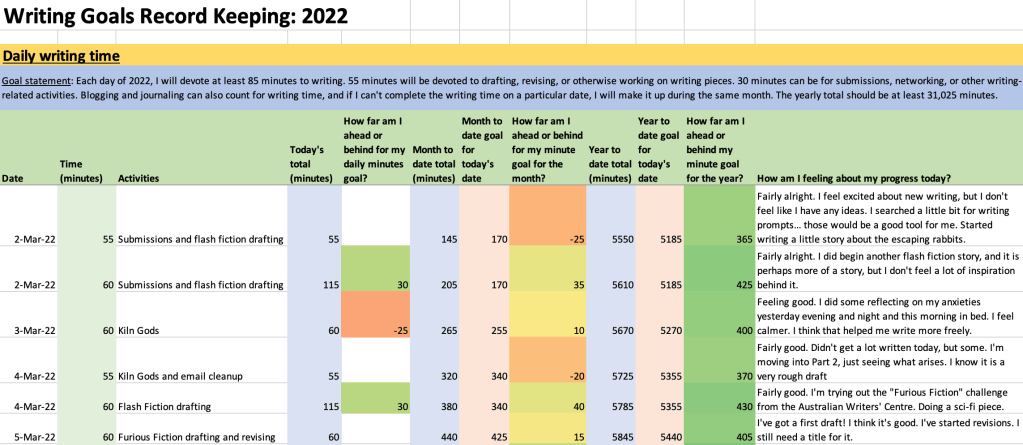
For each writing session, I note the time, the activities, and I write a short description of how I’m feeling, an idea I got from a writer long ago in the #AuthorToolboxBlogHop. And then, with the magic of formulas and conditional formatting, the spreadsheet calculates where I am relative to my goal, for that day, for that month, and for the year as a whole. It’s always a little pleasure at the end of a writing session to write the number in and watch the spreadsheet populate.
Am I meeting my daily writing time goal?
As you can see from the red cells on the spreadsheet, it’s definitely a mixture here. Some days, I simply do not have the time. Particularly at the beginnings of the months, sometimes I fall behind my number of minutes for the month. Yesterday, I thought I would do a second writing session in the afternoon. Then, my husband and I got our car stuck in the snow on our way to try to do a short hike. Three hours later, successfully unstuck with the help of our friend and neighbor, the opportunity had gone.
However, on broader scales, the answer is yes! I am doing it! Until this year, I was pretty consistent with a morning 55-minute writing session, but I almost never did any writing outside of that time. During January and February of this year, it became more normal for me to do a small chunk of writing in the afternoons. I’ve found the time. I’ve made it happen, and what a big change this is making for me!
For January and February, I exceeded my minute goal for the month, and at this point, I’m several hours ahead for the year as a whole. That feels powerful to me.
How else is this goal affecting my writing?
One unforeseen consequence of my 2021 monthly word-count goal was the way it pushed me towards drafting ahead of all other writing activities. Revision didn’t count towards that goal. Neither did research, submissions, or even blogging here on Words like Trees! Although it was a great thing to be producing new work, I also noticed that it encouraged writing quantity over quality. Sometimes I wrote knowing I would later delete everything of the day’s work.
The change instead to a time-focused goal is helping me rebalance my writing time. I’m still committing at least 55 minutes of the daily time to new work (drafting, revising, planning, working directly on a writing piece in some way), but I’m counting blogging now, and I’ve also included journaling sometimes in this goal, and I think this has really helped me acknowledge the importance of all of the activities I do as a writer.
New short stories
I set a (for me) ambitious goal of two new finished pieces every two months, twelve total for the year, six total flash pieces (under 1000 words), and six short stories (at least 2000 words). I’ve heard advice elsewhere that writers should strive to produce one short story each week. I don’t think I’m anywhere near that yet.
In January, I made almost no progress towards this goal at all. Instead, I was working hard on my novel draft, and I also think that I was subconsciously (or even a little consciously) avoiding the short stories. I didn’t have any ideas. I felt paralyzed with them. I have a lot of feelings that I need to process around this still. I made a few abortive starts, did scrawl the first couple of paragraphs of a story in late January, but all of this was half-hearted.
In February, I knew that if I was going to meet my goal, I needed to meaningfully begin, and with labored bursts and slow work, I did produce a short story, albeit with a lot of agonizing grappling, restarts, and self-doubt.
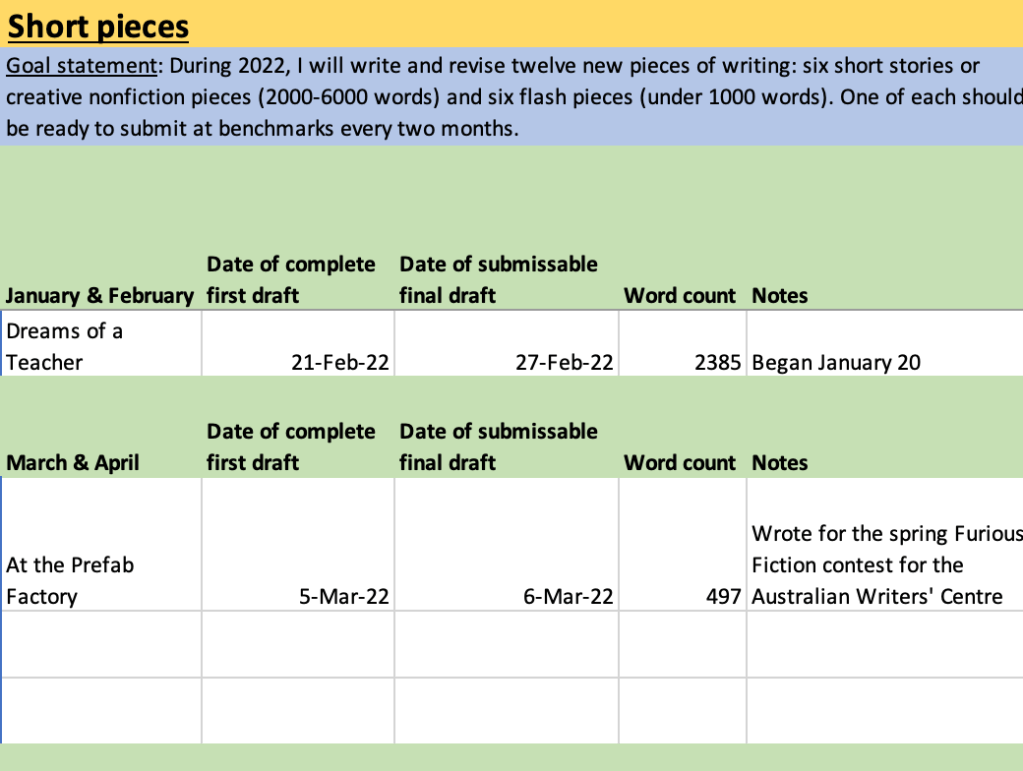
I didn’t complete a second short piece during February, but with a contest deadline near the beginning of March, I did put together a fun little flash fiction piece then. I’ll try for three short pieces during March-April to make up and hold to my yearly goal, but we’ll see. I recognize that this is a big challenge for me.
Submissions
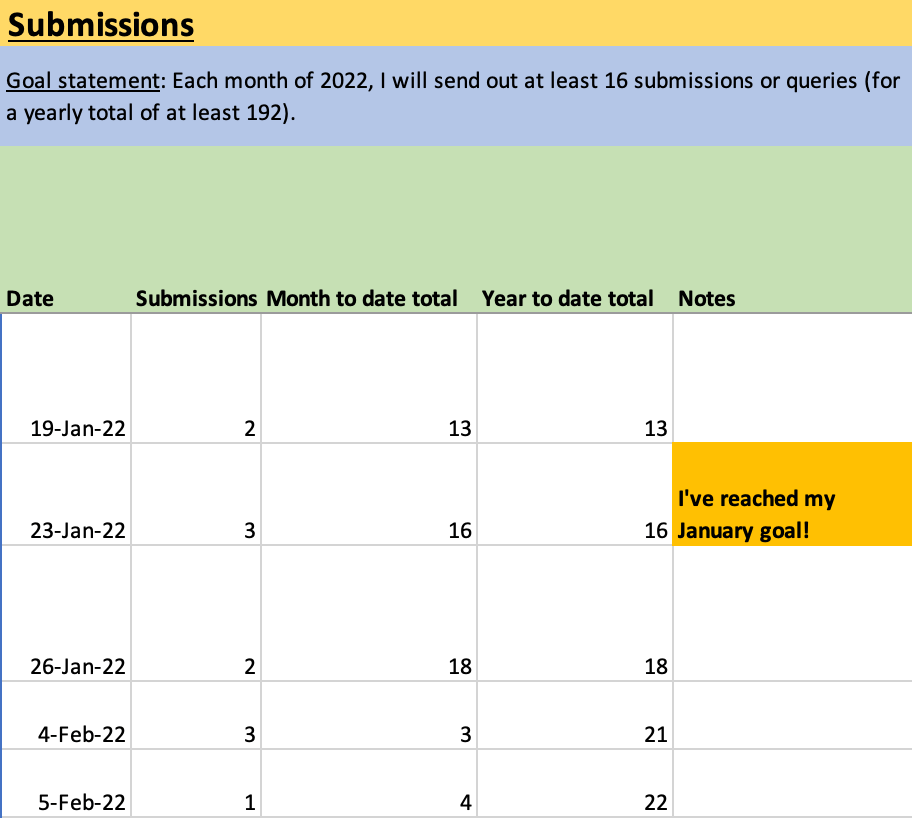
I’m plugging along with my submissions goal, which is the same as last year’s. The truth is, I’m getting drowned in rejections, which are hard when they come in such numbers. I have thought that it may be that I need to retire some of the pieces I keep sending out–maybe they just aren’t going to get picked up, and that’s alright. They have absolutely been learning experiences for me as a writer, and perhaps I’ll revise them at some point and start sending them out again. I’m not sure. I’m not retiring them yet, but as I write new pieces this year, perhaps I will.
Overall reflections
Goal-setting is a powerful tool to motivate and direct our energies. It’s important to keep it as a scaffold for our work and not use guilt and shame to strap us down. Then the goals end up hurting us. When we don’t meet a goal, we should strive to react with kindness and understanding. At the same time, if these goals are important to us, we should keep growing towards them, taking them seriously as meaningful intentions for ourselves. This is important enough to me that I am willing to devote energy and time. That is the strength of a good goal.
Are you working towards goals yourself this year, whether in writing or some other domain of life? What are you finding as the benefits and challenges? What are you learning about yourself in the process? I would love to hear.
Spring is on its way here. The snow is rapidly melting, and we’ve had a couple of clear, sunny days of late. That has been really nice. Covid is active on campus. Many of the staff are sick this week, and so I’m becoming very friendly with my facemask. We’ll see–I think it’s likely I will catch it, but I’ll take the precautions I can.
Best wishes to you in the coming fortnight, and happy writing,
Jimmy


It sounds like your goals are working well for you! I think adjusting goals based on what you’ve learned is just as important as having them in the first place. It is challenging to escape that cycle of guilt and look at what the goals have gained you, rather than just the times when you failed.
I haven’t been using hard deadlines, but I have been using my blog as a sort of virtual accountability partner, and it’s working well. I’ve been writing a chapter about every two weeks while working on other things. It’s not a blazing fast pace, but feels like a pace I can keep up long-term.
Also, I think producing a short story every week sounds crazy! That seems like a lot of work even for a full-time writer. Writing enough words is doable, but the ideation and editing would be almost impossible for me with that kind of deadline.
LikeLike