My biggest questions about stories the last few years have been focused on structure. What is the role of conflict? Do all stories really follow the same dramatic structures, or is this an oversimplification? What alternative story structures might exist (such as Kishōtenketsu), and how do they function in different cultural contexts?
When I asked some of these questions as part of a short story writing class I took last summer, the instructor recommended that I look at Matt Madden’s 99 Ways to Tell a Story (2005), as well as the book that inspired it, Raymond Queneau’s Exercises in Style.
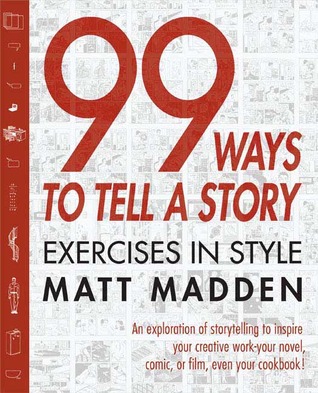
Queneau’s 1947 book (Exercices de style in French) takes the same simple story and re-tells it in a plethora of different ways, modifying the “style” with a host of alternative authorial choices. Readers can see how the story’s meaning changes. Matt Madden, a cartoonist, was inspired by Queneau’s work to apply the same idea to comic strips.
During the last few days, I have been exploring Madden’s book (I’ll head next to Queneau’s), and although I am not a comic artist myself, I enjoyed exploring the re-tellings, watching how particular changes in style could impact the narrative. I can see this as a really valuable teaching resource, and it also raises many of those same questions about how the way in which we choose to tell a story impacts the meaning we convey.
Madden’s website has published a series of excerpts from the book here. I’ll explore just a few of these in terms of questions of structure.

The template story
Read the excerpt from Madden’s website.
The template story that inspires all the other comics in the book feels relatively conflict-light as standard Western stories go, and in some ways that is perhaps its charm. It is a mundane, eminently relatable experience of getting distracted and then forgetting what we had gone into the other room to look for.
Yet although the stakes might be low, the story still follows a recognizable five-part structure:
Exposition: frame 1
In frame one, Matt sits typing at the computer. This establishes our protagonist and setting at an ordinary, cluttered desk. So far, there is no visible conflict.
Inciting incident: frame 2
In the second frame, Matt closes the computer and stands up. This is the beginning of our conflict, although that might become clear only later. Without any text in the frame, readers might wonder what he is getting up to do. In retrospect, we can imagine though what the conflict is: Matt is hungry, so he decides to get up to get something to eat.
This is, in a really low-stakes form, a “person vs. nature” conflict, as Matt is besieged by hunger. In the coming frames, the conflict will shift into something of a “person vs. person” conflict as Jessica’s seemingly innocuous question becomes an instrument of distraction for our poor protagonist. Readers might wonder, will he triumph in the end? Again, being so low-stakes, yet still a conflict, this irony creates some of the humor of the story.
Rising action: frames 3-6
True to form, the rising action of the story takes up the largest number of frames as the conflict develops. In frame 3, Matt travels from the office into the kitchen, and there, in frame 4, he meets his enemy: distraction. The first text that appears in the whole comic strip, Jessica’s seemingly innocent question, “What time is it?” comes from above like the disembodied voice of God.
The unwitting Matt automatically offers his reply in frame 5, and the conversation ends in frame 6 with Jessica’s “Thanks!” as Matt approaches his goal, which for the first time is now made clear: the refrigerator.
In terms of structure, we can notice how drawing the conversation with Jessica out over three frames gives it central importance. It also serves to continue to keep readers in suspense about Matt’s goal.
Interestingly though, unlike in a prose story, it is really easy and natural for readers’ eyes to skip ahead to see the refrigerator in the later frames, then return to the place they had left off reading. This is a feature of comics that in a way makes suspense harder to maintain for readers (at least in a one-page story). Yet it also helps maintain the ironic humor discussed above.
In this rising action section, Madden uses a few different shifts in visual perspective to emphasize different elements of the story. The long shots of frames 3 and 4 continue to establish basic details of setting and situation. The medium shot in frame 5 puts emphasis on Matt’s earnestness to answer Jessica’s question. Viewed from above, perhaps even from Jessica’s perspective peering down the staircase, Matt is portrayed as an innocent victim because of how the angle makes him appear small. This makes us sympathetic to Matt and so prepares us to adopt Matt’s subjective point of view with the close-up of his hand on the refrigerator in frame 6. The emphasis here returns to Matt’s goal: food. Thus it builds the tension of desire needed for the impending climax.
Climax: frame 7
I really debated about where precisely the climactic moment falls in this comic strip. If we see the climax as the turning point in the central conflict, I think frame 7 is the best place, yet interestingly, because we lack text, we need to read frame 8 before we understand the full significance of what has happened. Again, this is a really interesting difference between the visual and prose forms of storytelling.
In frame 7, we see Matt standing with a casual posture before the open refrigerator, staring into its depths. In terms of structure, this is the moment the story has been guiding us to from the beginning: the object of Matt’s desire that we first became aware of back in frame 2. We can infer that in this moment, the character is only just beginning to realize that something has gone wrong. He does not yet see that Jessica’s question has distracted him. He is expecting to reach into the refrigerator and find the thing he needs to assuage his hunger. Yet in a tragic turn of events, Matt’s attempt has been foiled.
I think the silent climax actually works really well with this low-stakes conflict. It maintains the lovely, quiet, wee-hours-of-the-morning atmosphere. That serenity is just about to be broken.
Resolution: frame 8
How does the conflict end? The beasts of distraction have triumphed and diverted Matt from his goal. He is still hungry, and now he is confused and frustrated, still perhaps unsure what it is that has derailed him.
This frame ties up loose ends, leaves readers laughing with the relatability whose significance also only appears at the end: we don’t realize that the story is about distraction at all until we arrive at the final frame. This might make readers go back and reinterpret the previous frames, seeing Jessica’s question not as an insignificant plot event but as the real cause of Matt’s downfall.

Let’s now look at two of Madden’s other permutations to see how a change in structure impacts the narrative:
Condensing the story
Read the excerpt from Madden’s website.
Structurally, this one-frame version of the original comic condenses the whole eight-frame template into a single image. How does this significant structural change affect the story’s meaning and impact?
First, let me say that I find this one-frame version remarkably effective in telling the whole story. We see the corner of the laptop computer that Matt has left behind in the other room (it is even “sleeping” with its emanata of “z”s). Readers follow Jessica’s and Matt’s dialogue as he stands before the refrigerator, and the top-to-bottom layout of the dialogue makes sure that we read it in the correct order. There is even a relatively effective attempt to replicate the suspense of the climax in the template: Madden has placed the punchline (“What the hell was I looking for, anyway?!”) far away from Jessica’s final “Thanks!” This visual distance makes readers pause: after reading the end of the conversation, our eyes must pass over Matt standing in front of the refrigerator; only then do we reach the punchline near the bottom of the frame.
Has something been lost?
By condensing the comic strip from eight frames down to one, we undoubtedly have a reduced experience of that suspense, despite the effective layout choices discussed above. We also, I would argue, have less of an emotional impact. Part of this results from the fact that we can’t see changes in Matt’s facial expression (or any facial expression from him at all). We have less of a chance to identify with him or sympathize with him over the course of time. We read the comic far more quickly, come to the punchline nearly right away, and might even have the feeling that we have been rushed through a story while missing its subtlety.
Has something been gained?
Yet I also think the one-panel version contributes a sense of cohesion to the story that we might say is absent in the template. By showing us both the office and the kitchen in the same image, readers have a sense of compressed space. We see the relationships between the three rooms (office, kitchen, and Jessica’s room upstairs) more clearly than we otherwise would. We see that the desk is directly against the wall of the kitchen. The visual layout gives an aesthetically-pleasing sense of perspective. The angle at which we are viewing is close, even intimate. We have the sense that we are there in the room peering through the door into the kitchen rather than a disembodied camera as we might have felt in some parts of the template.
We might also say that the one-frame comic has “cut the fat” from the story. It throws us immediately into the moment of distraction and its result, removing the scene-setting frames of Matt at his computer, gesturing at them only with the half-view of the computer at the side of the frame. If indeed it is a benefit to get into the action more quickly (although in my opinion, I liked those first two frames), then this version is successful.
What might this look like in prose fiction?
I might liken this one-frame narrative to a piece of flash-fiction or a vignette in prose. We give a snapshot of the character’s experience and compress ideas into a tight space. Some of the challenges of flash are similar to what we observe here: how to rapidly build vivid character, conflict, and plot while cutting extraneous elements is one of the hallmarks of flash.

Hyper-detail
Read the excerpt from Madden’s website.
In this iteration, Madden has expanded the story to a thirty-frame narrative that painstakingly presents detail after detail. We have long shots, close-ups, medium shots, multiple points of view, the additional plot event of Matt stopping by the bathroom. If we tried to map our five-part structure onto this comic, it might look something like this:
| Exposition | Frames 1-2: Matt sitting at the computer, writing his outline for “Exercises in Style” |
| Inciting incident | Frame 3: Matt rises from the computer |
| Rising action | Frames 4-22: Matt goes to the bathroom, sings a song, flushes the toilet, washes his hands, hears dripping from the bathroom, returns to jiggle the toilet flusher, hears Jessica’s question about the time, answers her, and then opens the refrigerator. We also see Jessica yawning upstairs at her drawing table. |
| Climax | Frames 23-28: Matt stares uncomprehendingly into the refrigerator, while Jessica sits oblivious upstairs. We see details of bottles in the refrigerator door, of half a carton of eggs, of cups of yogurt. |
| Resolution | Frames 29-30: Emanata suggest Matt’s confusion. He ends with the same punchline as the template: “What the hell was I looking for, anyway?!” |
There are some really interesting things going on in this version of the comic. Something that for me doesn’t work so well is that it feels cluttered. Details like the several frames dealing with the dripping toilet, the change to Jessica’s point of view upstairs, the slow thinking about how to read the time in frame 19, all of these feel busy, as though Madden were trying to show us every detail possible, ad nauseam, and these could be said to distract from the core of the story.
Perhaps I’m wrong here: perhaps actually the focus of the story has really changed. Maybe Jessica is no longer the primary cause of distraction–it is clearer that it is Matt’s own obsession with the dripping toilet that caused him to forget his goal. Maybe the story transforms here into one of self-defeat.

Something I actually love in this version is the expansion of the climax. By drawing out the climactic moment into several frames, including the disorienting close-ups of food (particularly the bottles at an odd angle in frame 24 and the awkwardly-cut-off egg carton in frame 26) the comic gives us a better sense of Matt’s confusion than we got in the template story. The brief cut upstairs to Jessica gives us a great sense of contrast between Matt’s confusion and Jessica’s serenity and unconcern, which emphasizes Matt’s frustration. Expanding the climax also gives us a greater feeling of suspense.
What might this look like in prose fiction?
In our effort to create detailed worlds, sometimes we might overdo it. We should strive for telling details that contribute to a rich portrayal of our stories, but we should be careful to avoid supersaturating the story with details that don’t meaningfully contribute and might risk distracting readers.
In a really positive view, though, I would argue that taking the time to expand our climax scenes, using close-ups and focus on character emotion, can make them more impactful.
I definitely encourage you to read Madden’s full book. You can also check out a variety of other excerpts here, including some fourth-wall-breaking, conceptual, and genre-bending iterations.
I’m going to keep thinking about these exercises in style, and I’ll be embarking too now on reading Queneau’s book that works directly with prose fiction rather than comics. Hopefully this will keep deepening my understanding of how our stylistic choices as writers can change the stories we tell.
Best wishes, and thanks for stopping by,
Jimmy


