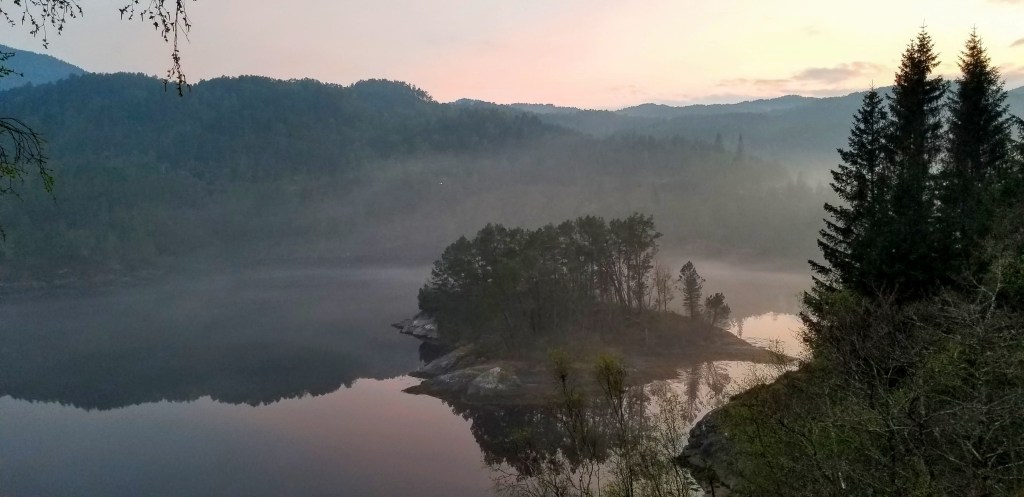
Spring keeps burgeoning out. Already the crocuses are a distant memory. Daffodils are fading now. In the woods, anemones and cuckoo flowers are everywhere. In our yard, a volunteer patch of forget me nots has sprung up. I’m used to forget me nots being a beautiful purple-blue, and a few of these are, but many are also a bright white.

On Wednesday, Norway celebrated its national holiday “Syttende Mai” (the Seventeenth of May) with a parade through the village and a brunch of the traditional sour cream porridge “rømmegrøt.”
Due to weather and a unit to plan for my English literature class, I missed the parade. I’m currently teaching Dario Fo’s farcical play Accidental Death of an Anarchist, and so spent much of that day preparing slides, choosing close reading passages, and developing discussion questions.
The play is a hilarious look at a very serious topic: the 1969 death of anarchist activist and railway worker Giuseppe Pinelli in police custody. On scanty evidence, Pinelli and other left-wing activists had been detained following the terrible Piazza Fontana bombing in Milan. Police originally stated that Pinelli had committed suicide. The final judicial verdict on the case was that Pinelli’s death was “accidental.” These events were part of a larger period of political violence in Italy between the late 1960s and the early 1980s, with terrible attacks perpetrated by both left-wing and right-wing groups, known as the “Years of Lead.”
According to our school’s history teacher, who is Italian herself, these years contributed to a general distrust of institutions in Italy, which in many cases still to this day have failed to bring justice for the victims of political violence. It’s a marked contrast to Norway, where trust in public institutions is quite high. I think, then, about the United States, where Black Lives Matter has pointed out injustice in policing and other institutions, where election deniers destabilize faith in a democratic process, and where a failure to address gun violence continues to erode trust in legislatures. I wonder what this means for the decades to come.

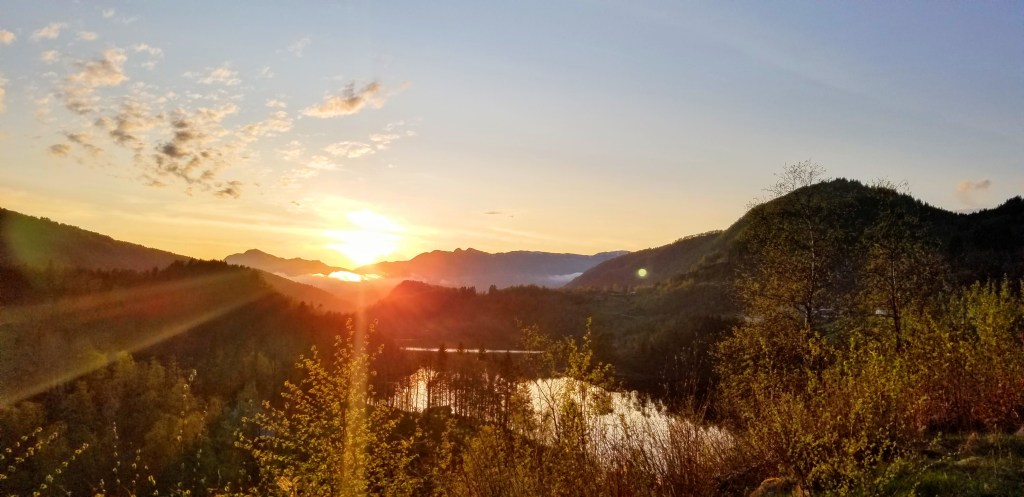
On the evening of the Seventeenth of May, the sun emerged. We went out for a walk. By serendipity, we happened to run into our school’s rector who was heading out for an evening paddle in the wooden boat he has been restoring together with students this school year. And so, in the long evening light, we found ourselves paddling a rowboat over the fjord.
This is the first time we’ve been out in this boat, but we have found ourselves on the fjord other times, on kayaks or on an expressboat for the school trip to Svanøy. But there was something different about rowing in this large boat, which could probably accommodate eight or ten people, a replica of the boat once used by the sheriff of the area. Here we were, in the sheriff’s boat. My husband Taren and the rector rowed at first. Then I joined in also. Working together, we moved remarkably quickly over the fjord in the dying light.

Saturday was graduation. In another of these yearly celebrations of our wonderful students, who are heading out into the world for the next chapter of their lives, it was something special to be witnessing this ceremony of transition, as all of us get a little older, as these countries move forward in their histories, as the old boat sails again.
Thanks for reading. Best wishes for the coming weeks,
Jimmy