
Earlier this week, earth crossed the equinox. Days in the northern hemisphere are longer than the nights now. Here in Norway, the sea change between winter and summer is always so dramatic, and around the equinox daylight change is the fastest. We’re headed into sun and light. We’ve had a smattering of beautiful clear days amid the rain. We’ve got two pots of spring bulbs that my husband planted up last autumn, and one of them is beginning to show signs of life.

I’m thinking a bit about this blog–when I began Words Like Trees back in December 2018, my goal was to connect with other writers, a vague idea of “sharing thoughts.” In the early days when I wrote weekly posts, I worked to share my knowledge about writing concepts and techniques, and still today when I look at which of my posts garner the most views, it is those ones: my early exploration of Kishōtenketsu story structure, a post on mode, genre, and form, an odd little discussion Aldous Huxley’s theory of essay writing. The post that receives the most visits these days is from October 2019, when I wrote in depth about simile, metaphor, and symbolism.
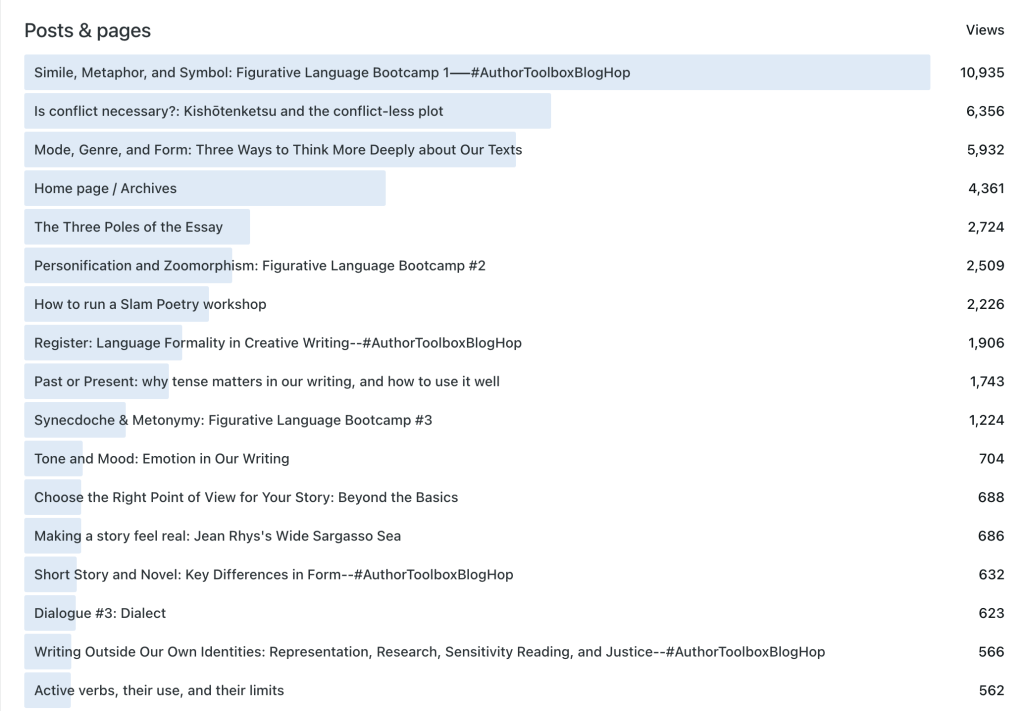

I don’t write so many posts like that these days. In truth, I think sometimes in 2018 and 2019 when I wrote most of these more educational or theoretical pieces, what I was not doing was putting so much time into my fiction writing. I’ve chosen to reallocate, which I think is the right decision for me.
That said, I’ve not stopped thinking about these things. I thought today I would just collect a few of the scattered thoughts about writing and literature and teaching that have been with me recently. Maybe these will become a post at some point, or maybe they will just live here. Here’s a short list:
Irony
In my teaching, I’ve been exploring irony in The Color Purple, in editorial cartoons by Paresh Nath, in the play Accidental Death of an Anarchist. Irony is a slippery concept, involving, in its broadest forms, a mismatch between appearance and reality. I talk about irony a lot with my students, but I still don’t think I truly understand it–I think as a person, I tend to be not very ironic, and I tend to resist irony in my own writing. Yet as a tool I think it has so much power. I’m interested in exploring more how it works, how it can be used, and what meaning irony as a lens can give us on the world.


Artificial intelligence
Since it burst onto the world’s stage in November 2022, ChatGPT and other generative AI tools have already become commonplace. In the classroom, teachers and students are grappling with the right ways to engage. This has been a struggle for me. While I began my AI explorations with enthusiasm, I have recently become more cautious. I worry seriously about the potential for AI to muddle young people’s critical thinking skills (despite ideas like this about how AI can spur us on to greater critical evaluation of our own ideas). I am concerned about what I see in my students–students typing discussion questions into the chatbot, or using the chatbot to generate ideas of essay topics. I worry about how quickly and uncritically it has become central to many young people’s engagement in school.
More broadly, I have been reflecting about the kinds of texts that we as a society consume. I worry about the way internet searches cause people (that is, most nearly, myself) to find information in scattered and disparate fragments without quality control. I notice the way I, as a child of the internet generation, learned to seek information wherever it was available and to take pride in the ability to find wide-ranging sources quickly. When I teach, I seek out resources everywhere, which in many senses is freeing and good and should lead to a democratization of information. Yet I also am recognizing a loss–of carefully curated and assembled collections of texts, as in a published book on a topic. Of course, such resources have their own problems, of ivory-tower-expert-valuing and the ways in which this disenfranchises thinkers outside the mainstream. In the era of generative AI, however, I worry that the types of texts that will be available and widely consumed in society will become increasingly AI-generated, and that this risks perpetuating uncritical reading in an even more damaging way.
I don’t know what the right attitude towards AI is. I don’t know how to move into this new era of our species in a way that promotes the most good for all of us.


Conflict
Since Words Like Trees began, I think my most significant internal conflict around writing has been grappling with conflict itself as a structure in literature. I still question the idea that conflict is an essential ingredient in a good story, even as I recognize myself working closely with conflict in my own writing projects. I am looking for other organizing principles that can engage readers and bring meaning–I think about the role emotional connection plays in a story; I want to lift up the primary role of character, or maybe just beauty. I don’t know. I feel a bit silly, perhaps, when I write these things. But for me, the jury is still out on conflict. Maybe one of these days I’ll pick that thread back up and write another post.


Final thoughts
I’m not sure where any of the above thoughts will go, what I’ll turn at some point into blog posts, what I won’t. For now, I’m content to keep going as I am. Wishing you all a really good next couple of weeks, and happy writing. Thanks for coming by to read.
Jimmy



Leave a Reply