Content warning: this post contains discussion of genocide and associated acts of violence, in the context of a literary analysis.
The week has been packed. On Tuesday and Wednesday, I led student orientation workshops on diversity, introducing ideas of social identities, individual differences, and how assumptions arise when we meet people different from ourselves. The workshops went well–students and colleagues seemed to find them meaningful, and that set the week off to a good first half.
That was the theme of this week though: all good things, truly, but so many of them that I’m already half falling behind the rush. Wednesday night, I planned lessons until eleven, for Thursday’s first full day of lessons. Thursday night, we had my advisory group over for apple crisp, after which I was emailing students who haven’t yet been able to arrive on campus due to flights and visas. Friday was classes again, afternoon meetings with students, and my husband’s advisory group in the evening. I know this weekend I have reading to do to prep for next week’s classes, and assignments in a virtual professional development workshop that I’m halfway through.
I sure preach balance, but I sure have a hard time achieving it, at least early in the school year. I recognize that perhaps I set too high of standards for myself. It’s easy to do that, when there are young people in front of you who deserve a clear and engaging learning experience. I dread teaching poorly.
That is my weekly plea to myself, clawing at the wet sides of the swimming pool. Slow down, Jimmy. Let good enough be good enough.

In that spirit of slowing down, I thought today we would look at something small: not a whole text, but just a title. Those few words that name the text, that set up readers’ expectations, that need to give enough of a clue so readers aren’t misled, yet get them asking enough questions to start reading.
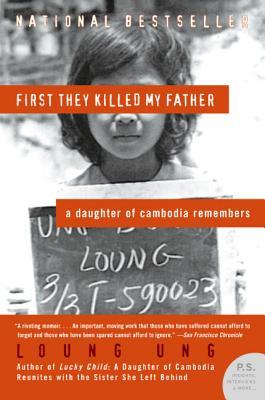
I’m taking on a second-year English Language & Literature course from a friend and colleague. This week, we began our study of Loung Ung’s memoir of the Cambodian genocide, First They Killed My Father: A Daughter of Cambodia Remembers. Ung was five years old when the Khmer Rouge stormed Phnom Penh in 1975. The book tells her family’s harrowing story, inviting readers to witness the events through the eyes of a child narrator.
Ung’s work of testimonial literature has come under criticism of inaccuracy, of having backfilled the understandable gaps in a child’s understanding of such events with poor research, but it has also been praised for its emotional power, helping readers to get some idea of what the horrors of genocide might mean.
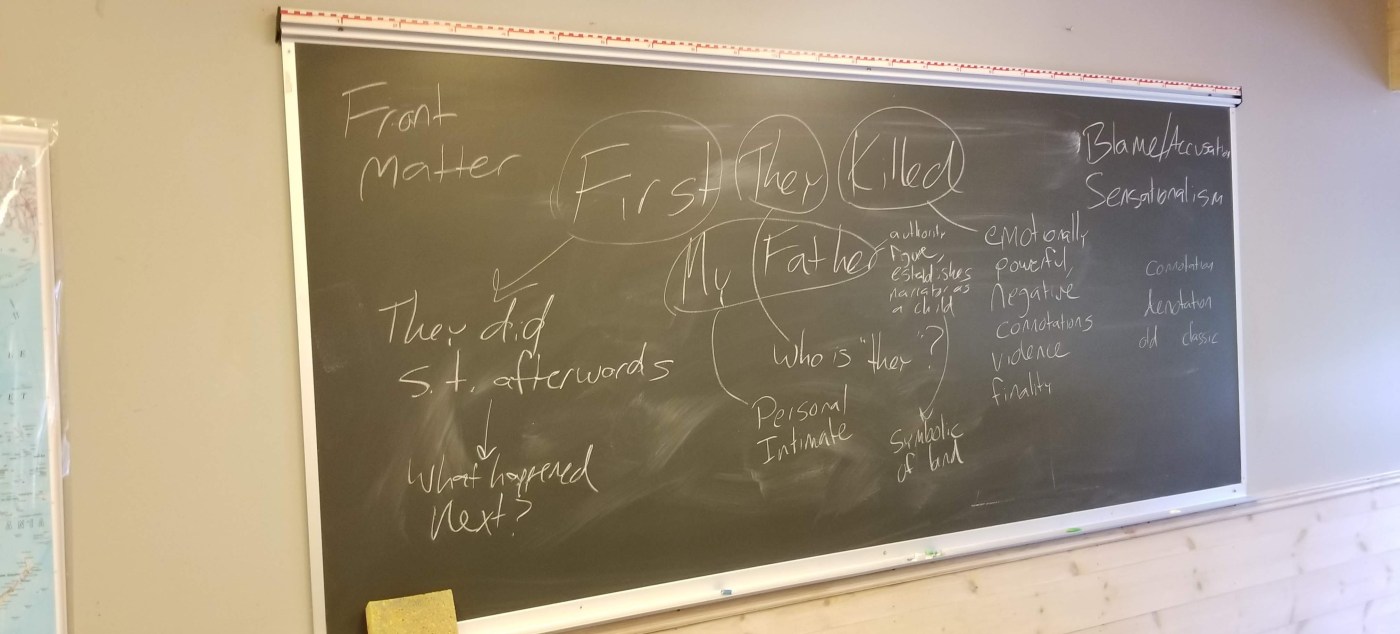
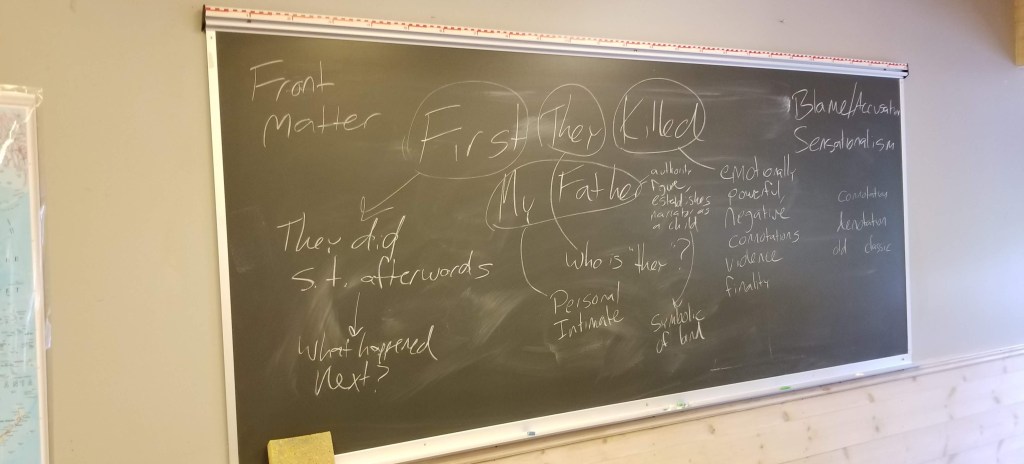
In class this week, we started only with the title. I wrote it up on the board and asked students to exercise their skills of textual analysis. What words do you notice? What stands out to you? What followed was an incredible range of ideas that deepened my own understanding of these five words far beyond my initial thoughts. I’ll try to recapitulate some of these ideas here.
First
The “first” in the title sets up the idea that this story is a sequence of multiple events, that the killing of the father was only one in a series of atrocities. “First” adds to the reader’s curiosity, has them asking questions–if this was first, what was second?
They
This word contributes to the reader’s curiosity: who are “they”? Interestingly, while “my father” is specific, “they” is general: a large group of people. The most likely word to replace “they” with would be “the Khmer Rouge,” the broad political assemblage that perpetrated the genocide. Thus the “they” alongside “my father” creates an interesting juxtaposition of the intimately personal and the political and general. This is a tension that runs throughout the text, as Ung tells the very individual story of her family in the enormous, country-wide event that was the Cambodian genocide.
A student also brought up the heavy sense of accusation in this title, and I think the “they” bears much of the power of this act of blaming. Convention in English is to use noun phrases for titles–The Color Purple; One Day in the Life of Ivan Denisovich; The Left Hand of Darkness. Ung’s title is a whole sentence, with subject, main verb, and a direct object: the relationship between the “they” and “my father” is made blisteringly clear: they killed.
Killed
Much of the emotion of the title comes from “killed” with all its provocative directness. It connects us immediately to violence and atrocity.
A student pointed out another tension in the title that emerges here: “killed” connotes finality. It is an ending of something, while the “first” creates the expectation of further action. The ending of the father’s life is thus only one part of a larger story, and this perhaps says something too about the horrors of genocide, that genocide in so many ways is an ending, and yet the history of Cambodia continues. Time stops, they say, for no man.
My
Ung’s personal connection is here. There is an intimacy to “my father” that establishes the personal testimony that unfolds through the book.
Father
“Father” might bring to mind an authority figure–we might think of a changing of authorities, as the old are dispatched and replaced by new ones in times of societal upheaval (I think here of Sylvia Plath’s poem “The Colossus”). This “father” being the last word in the main title, it hangs in the reader’s mind with all the sense of personal loss the title as a whole implies. The reference to “my father” also establishes the identity of the narrator as a child, and this is reinforced by the appellation “daughter” in the subtitle.
A student noticed too that there is a convergence, perhaps, of “father” with the idea of “fatherland,” of Cambodia as a whole country. The subtitle again makes this convergence clear, when Ung calls herself “A Daughter of Cambodia.” First They Killed My Father is not only the story of the death of the father, but of Cambodia as a whole, and in this word the personal and the national are mixed.
At the end of our explication of these five words, another student brought up an uncomfortable feeling: “I feel like I’m supposed to feel really emotional about the title,” she said, but something in it felt forced (and here I paraphrase, because I can’t remember the student’s precise words). Something blocked the emotion she felt should be there.
I brought up the idea of sensationalism, which Ung’s narrative has been criticized for. Is there a sense in which the title tries too hard to shock, and thereby undercuts the purpose it sets out to achieve? We’ll see what students find as they read the text itself.

I was so impressed with the students’ ideas–they are ready for deep work, and I am also sitting here reflecting still on titles, on the role they play in the wider work to set up expectations, questions, points of emphasis. In the run-up to publication of my story “I Dream of This Tree,” I had good dialogue with the editors of J Journal about the best title. We changed it several times until we arrived here, and it makes me think about what I title each of my works, how they might mean something different with a different title.
What do you think about the power of titles? How do you go about choosing a title for a piece of writing?
It is weekend, and I’ll make sure to take a little time to rest. But school life marches forward. Wish me luck. Best wishes to all of you, with writing and with all else,
Jimmy


