I nipped into the ceramics room during my free block the other day, flipped the kiln on so the temperature would show–24 degrees. I flipped it off. I’d left my two bowls at the bottom of the kiln, quick glazed them up last week after five hours of oral exams, until at last I could go home, collapse, and watch TV until my brain rebooted up. Let Lasse load the rest and start the fire. And this morning I returned to check–quick unscrew of the fastenings–one, two, and the third one that pops back on its spring. The door opens. I blink.
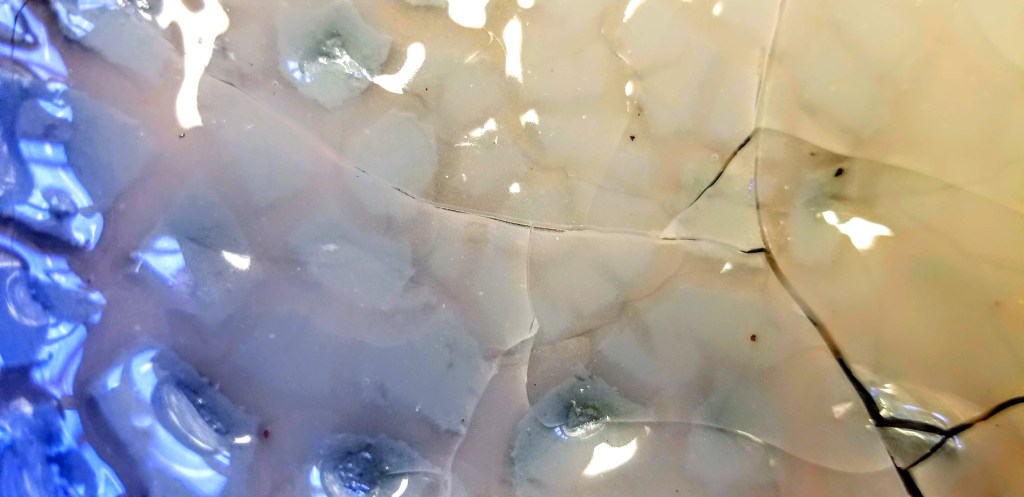
They have been cool for at least twelve hours now, but still I hear the occasional tinkle of fresh pottery as the glaze undergoes its final transformation, the crackling craze of spider-web where the glass coat shrinks just a little more in the last cool, buckles around the hard-back clay. Sometimes even weeks later, sitting on the counter now at home, a quiet house, and you will hear just one more chime as the tension in the glass releases, at last now, at a crack.
But I am pressed for time, as one is during a prep hour if one wants to use it well, and I kneel down to peer beneath the lowest shelf, the kiln floor, and I see a few of Lasse’s pots in front that I pull out in a fever, place them on the table behind me. I reach into the dark. There’s still a vague warmth to the kiln shelves as I brush them. And here comes my first–the large green bowl, glazed over in its new coat of transparent gleaming, thick enough to smooth the blemishes–fine, and it looks good, and I reach once more, the prize, the accident of glaze at the wrong temperature first firing, that happy accident healed over now with the sealing transparent second coat–
I can feel it before I see. A sharp edge. Rough clay. And already in that moment my heart has sealed against it, as all potters’ strong hearts must, already casting it down into the trash heaps of our memories, for pottery is always at the mercy of the gods, and I have learned the hard lesson many times, that it’s best not to, at least before the final firing, to get too close.
In these three years in Norway, my passion for ceramics has quietened. Perhaps it’s as my passion for my writing has gained steam, and it is too because the studio here, as wonderful as it is to have, lacks the high-fire reduction kiln with which I fell in love. The pottery here is of another order, more predictable, more the feeling of a child’s art project and not the alchemy. So it is, and that’s fine. Hobbies wax and wane, and we go on. But here, in this studio this morning, a bit of that old relish kindles up. I could not question my excitement. Now I cannot quite hold off the cringe.
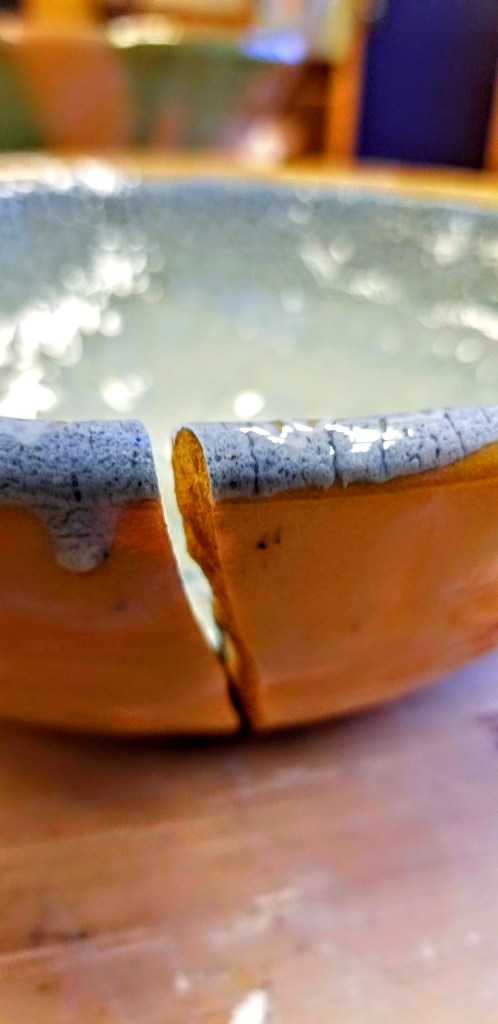
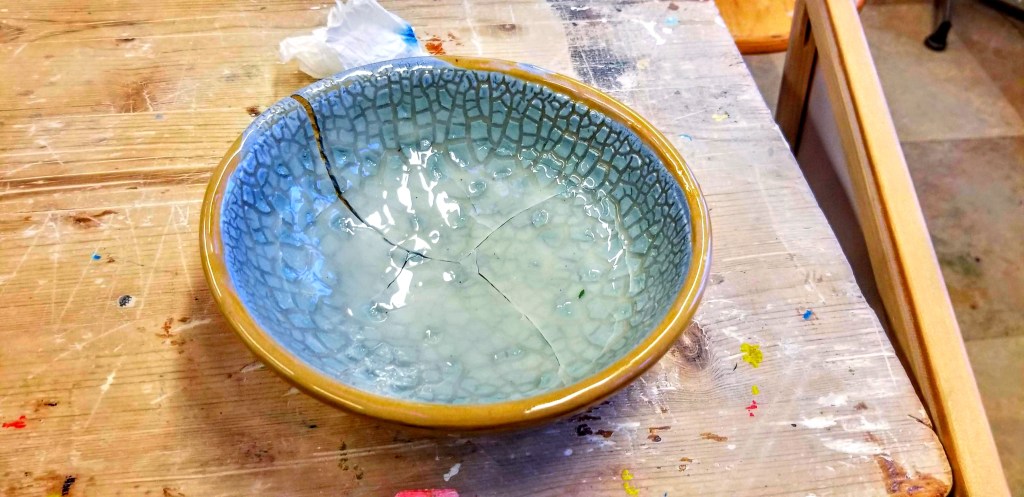
The pot has cracked cleanly down one side, splintered-out over its floor so that two small shards appear wholly cut out of the rest (yes, I can pick them up, sharp against soft finger pads, and they fall clean out when I invert the bowl). The body of the pot itself is not quite split–somewhere the join persists, for I can hold it at one place, and it does not fall apart (although at every moment I still fear it will). I study the crack as I set it carefully upon the table. All the way through, a full quarter-inch wide, a chasm really, if it led somewhere unknown, and I can see the full cross-section of the clay, its wry and toasted ochre-yellow, unlike any other clay I’ve thrown. I smile in regret. I pull out my phone. I snap pictures, for memory.
As my engagement with ceramics has pulled back, our friend Lasse’s has ballooned. He is in the studio nigh every day, molding cups and plates, and enormous serving bowls that make me nod, enlarge my eyes. He is enthusiastic and messy and experimental and haphazard. In this firing, he’s loaded imprints of his son’s feet and hands, pierced with a little hole to hang on the wall, I’m sure, for grandparents, he says.
In September, Lasse, arrived back from Denmark with seventy kilograms of clay he’d dug from some kind of delta on a beach along his road on back to Norway. He says the water filters it somehow, unclogs its line and settles out the clay–a real machine of nature, I suppose, just waiting for a shovel and a wheel.
I’d never worked with non-commercial clay before. That’s what sparked the fire in me again, I think. That beautiful, raw clay, which Lasse has now dried and sieved, reconstituted and pugged twice. It is silky, without grog, a deep, defiant gray before it’s fired. “Go ahead, use as much as you want,” Lasse told me in September. “Just don’t tell the students where I keep it, or it’ll be all used up.”
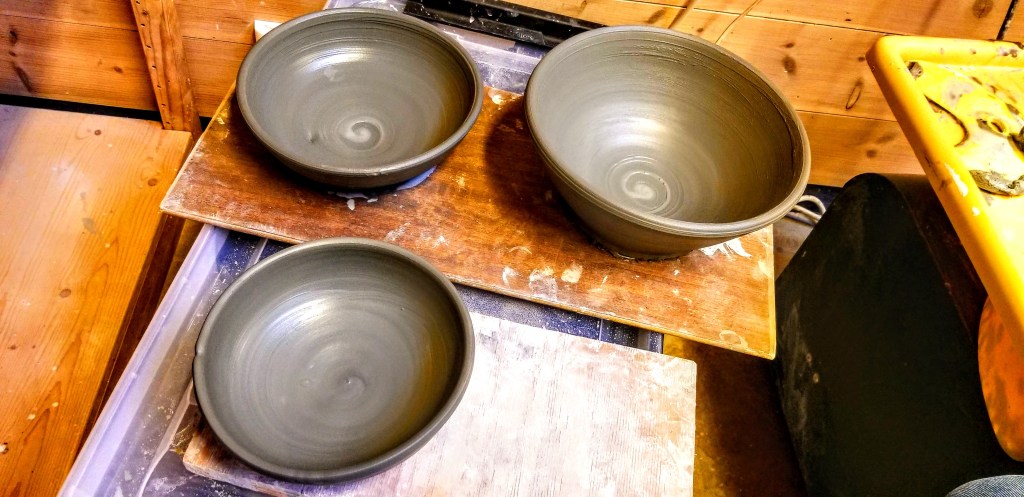
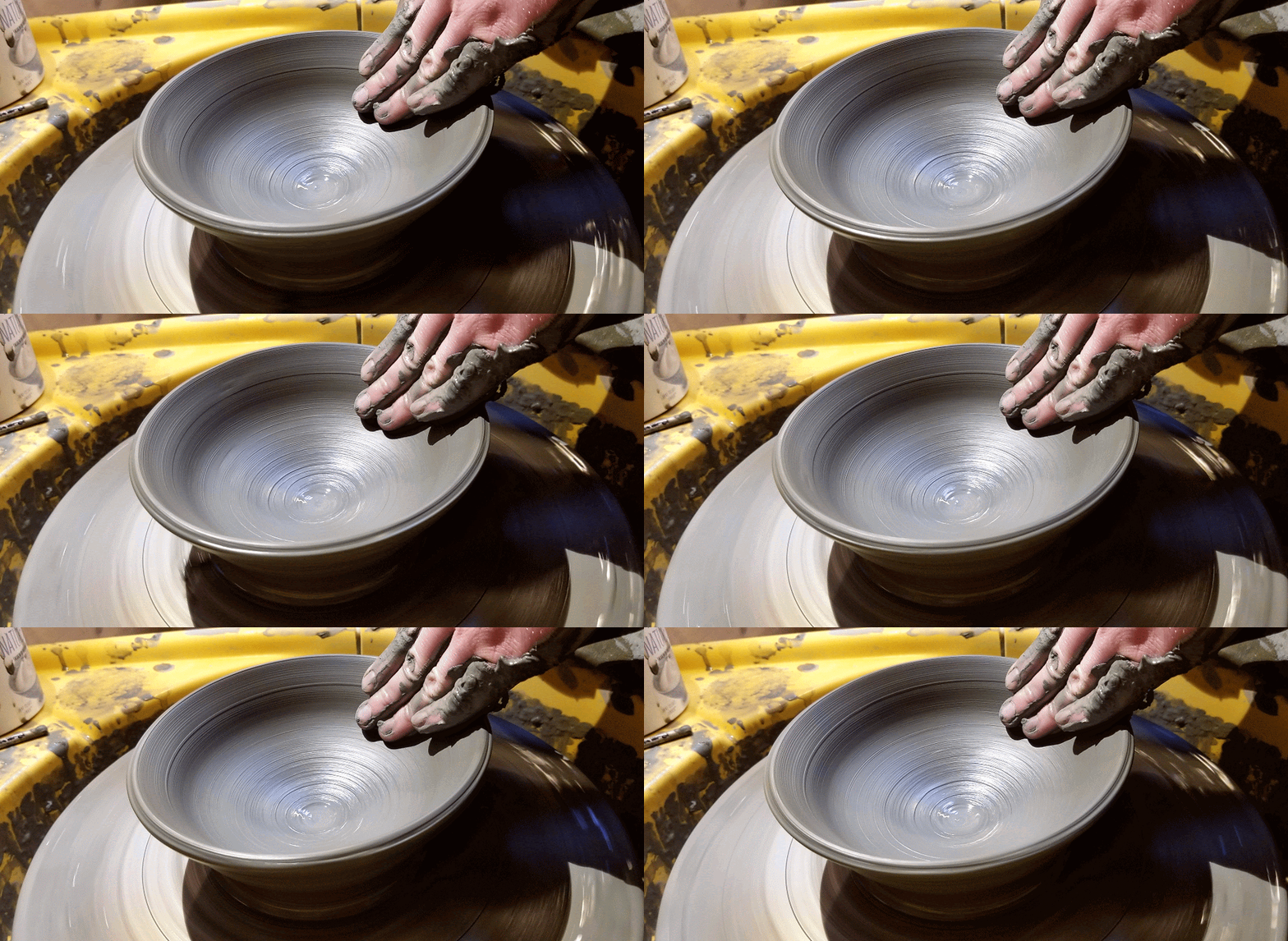
So one fall afternoon, I threw three bowls, the first pots I’d made in what must have been a year, and the gorgeous and smooth spin-out of that clay beneath my fingers: I remembered why I love it. The smell of it. The pliable rush beneath the hands. Here I go, I remember thinking. Now through that crack along the wall, it went.
What do we do when a piece of art just fails? It’s a question perhaps more applicable to ceramics, where, at least as a functional piece, a cracked bowl is without mend. In writing, discerning that point where a piece cannot be salvaged–it may be hard to determine, or, perhaps, it does not ultimately exist. But I think most of us give up on our projects from time to time. There’s a grief with it. There’s something of an embarrassment. In writing, perhaps, it is more personal, without kiln gods to take the blame (or the credit, if it comes to that), nor, as exquisite as a pot may be, does it quite contain the self of a deep story, at least not so in the eyes of the viewer. Ceramics is an art less in our hands, perhaps, so paradoxically. Yet, in a way, writing is not so different. It is the world we are depicting in our craft, and it acts by its very being upon the art. The mercies of our imaginations too are there, and these are perhaps not so different, in a way, from heat and physics and chemistry. Chimeras of the world. We can only try our best.
The blue cracked bowl–I have not yet thrown it out, although throwing out will surely come. There simply isn’t space left on the shelves for another decorative pot, so if it can’t function as a bowl for eating–
We must love our creations, even as we relinquish a certain amount of the control we seek. And what that balance is–well, the line is somewhere there, obscured, or perhaps just mapped each time afresh. Sometimes it springs open like a chasm, going somewhere–
Best wishes to you all. Happy writing, happy living.
With love,
Jimmy


You didn’t mend it with pure gold? 🙂
LikeLiked by 1 person
I have seen that and would love to try it sometime! 🙂 It’s a really beautiful way of making something good out of an accident. Unfortunately with this particular piece I don’t think it would work, because the crack resulted from stress in the kiln which actually distorted the shape of the pieces, so they wouldn’t quite fit together. Maybe someday. 😁
LikeLiked by 1 person