Human languages glitter with variety. Rife with synonyms, recursive structures, nuances of tone and pronunciation–the ways we speak and write possess the subtlety of art. Today, we’ll examine how sentence structure in English can be modified to bring our texts to life. Let’s see.
Linguistic Background
Multilingual people often debate the merits of their languages. Which are sexist? Which are most poetic? Which languages sound beautiful, and which are blunt and coarse?
It really is a fish-in-water-type scenario–what, after all, does English really sound like to non-English-speakers? Only people deeply immersed in multiple languages can probably speak to real differences in how they work, although even here I expect context is ultimately king: that someone who speaks one language with their family and another at work sees the two inextricably through the lenses of these situations.
When I was studying German, I was amazed at the word-order variety permitted and indeed used routinely in the language. Because German words are highly inflected (that is, their function in a sentence is frequently marked by a change in word form), word order is freed of the burden it has in English. Latin is even freer than German, whole sentences being potentially reshuffled to meet the writer’s aesthetic choice.
| German | Der Hund isst den Apfel. | Den Apfel isst der Hund. | Den Hund isst der Apfel. | Der Apfel isst den Hund. |
| English | The dog eats the apple. | The dog eats the apple. | The apple eats the dog. | The apple eats the dog. |
By contrast, English has very few inflections. We change I to me and she to her depending on grammatical function. We add -s, -ed, -ing, and sometimes modify the stems of verbs (drink becomes drank in the past tense). But ultimately, there’s not much more.
Without inflections to light the way, English must base most of its syntactic sense on a relatively rigid subject-verb-object word order. This mostly bars away the variation so marvelous in German (there are exceptions here; it’s not completely taboo in English to use a sentence like “This I like!” [object-subject-verb], although it does sound a bit strange). When I first realized this paucity of option, I mourned English a bit for its curmudgeonly simplicity. We were so stuck in boxes.
Myriad English Structures
The reality is that English word order allows quite a bit of variation. Whether the range of possibilities is rich as other languages–I don’t think it ultimately matters, for any toolbox, intimately enough known, can do a brilliant job. Let’s examine a snippet of great sentence structure, then look at how it works.
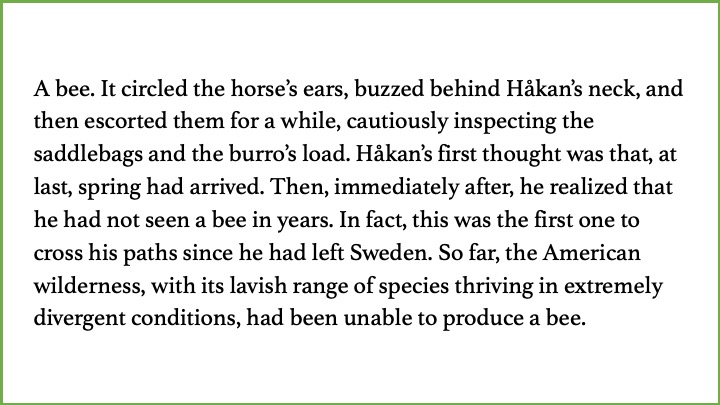
The above passage comes from Hernán Díaz’s novel In the Distance, a marvelous exploration of immigrant experience and the too-oft-oversimplified American Wild West. Attempting to cross from California to New York to find his brother, the young Swedish man Håkan encounters a perilous, shocking, death-defying adventure of the body and the heart. I’m about halfway through. I’m enjoying it.
Díaz does some strong work with sentence structure in this little paragraph. Let’s examine a few particulars:
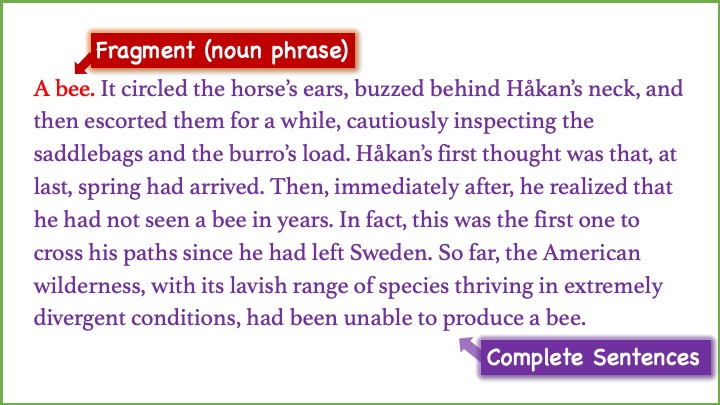
The most immediately salient syntactic decision has been the initial sentence fragment. A fragment is an incomplete sentence, and its effect can be dramatic. Here, the paragraph opens with a stand-alone noun phrase: “A bee.” This staccato introduction launches the reader forward and immediately halts, causing us to linger over that mention of the bee with the same close attention as the character. If the fragment had been incorporated into the following sentence (“A bee circled the horse’s ears…”), its power would have been significant reduced. The grammatical choice is thus deeply bound up with the meaning of the story.
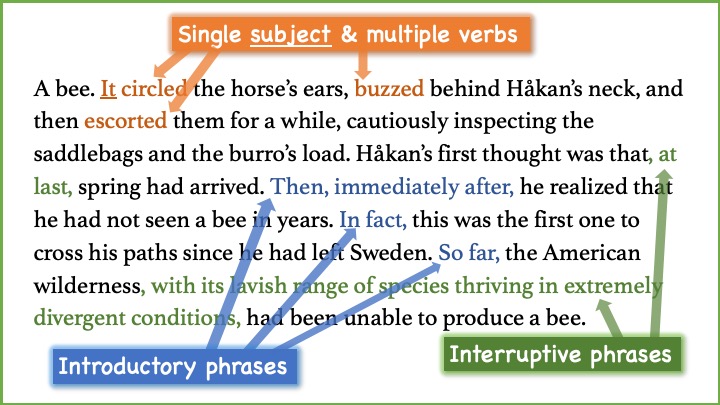
The first complete sentence of the passage takes the opposite approach of the previous fragment: it gives us a single subject (“it,” the bee) and lists out multiple actions all in a rushing list. This gives us a greater sense of movement, which perhaps reflects the insect’s darting course.
But the pace of the text does not stay quick: Díaz slows us down with periodic phrases mostly concerning time. Sometimes these appear in the middle of a sentence, interrupting the flow of ideas to highlight one aspect. Less pronounced are the set-off phrases at the start of some sentences, which slow us down less but still do not allow the quick jump of a more streamlined sentence structure.
This starting and stopping, this variable speed of reading, keeps us engaged, but it more importantly traces the mental actions of Håkan himself and thereby promotes sympathy with the protagonist of the story. We feel close to him, because we are going through some level of the same experience.
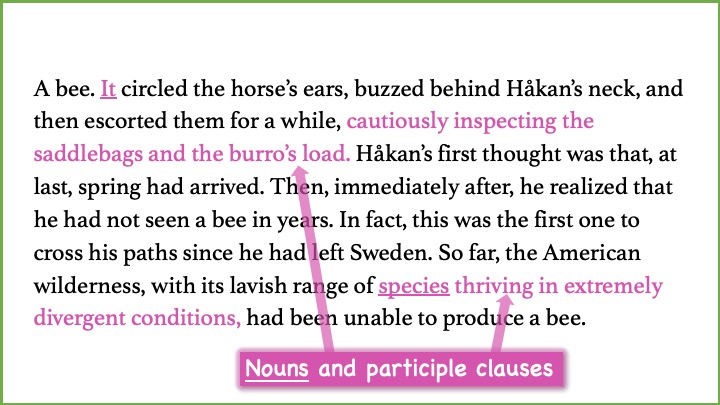
A final gem of Díaz’s writing are these two participle clauses. Participle clauses (sometimes called “reduced relative clauses”) employ the -ing or -ed forms of verbs to make a long descriptor for a noun. These clauses embellish the nouns and add variety to an otherwise monotonous list of conjugated verbs. Less consistent in effect, the participle clause can sometimes rush the sentence on and sometimes slow it down. If short, it can inject a detail without the reader quite realizing it was there; longer participle clauses can lend an air of sophistication and suspense.
Practicalities: Varying Sentence Structure in Our Writing
Few writers consciously consider which sentence structures they will use. Indeed, until I began teaching English to non-native speakers, I didn’t have words to talk about many of these structures. Most of my own syntactic decisions happen by my ear. Multiple possibilities might present themselves to me for the rendering of an idea; I choose the one whose cadence seems to fit.
However, in revision, explicit attention to structural elements can help us make decisions that affect readers in the ways we want. Aiming for effects on reader speed, reflection of character experience, and simple variety for change of pace can keep our writing fresh and engaging.
I would further argue that sole reliance on the ear may wall us off from widening our syntactic toolbox. Look at your own writing. Consider these questions:
What structures may be overused?
Relying on the same structures too heavily robs them of their emphasizing power. Just as we might revise with an eye to repetitive vocabulary, repetitive sentence structure can deaden our writing. How can we incorporate more variety?
This is not to say, however, that a repeated sentence structure is always the wrong choice. The great rhetorical power of parallel structure draws on precisely this. However, we should use it intentionally, and not default.
What structures are wholly absent?
In a similar vein, as we become more familiar with the range of sentence structures available, we may find that some of them never or rarely appear in our own writing. An intentional move to include these neglected structures can make them come more naturally in the future.
What do I want to highlight or obscure in the text?
Varying sentence structure for the sake of variety alone has limited merit. At its heart, diversity of structures is at its best when it fit with a particular element of meaning. Move words you want to emphasize to the power positions in the sentence (the first and final places). Surreptitious clue-dropping can be squirreled away in subordinate clauses in the middle of the sentence, frequently breezed past by readers.
How do sentence structures fit tone and voice?
Sentence structure is a key element of a narrator’s voice, and a different tone or personality of the narrator may fit best with a particular syntactic style. Is your narrator wordy? Brisk? Angry? Ebullient? Longer, shorter, convoluted, sparse–the range of sentence structures available is a powerful tool for expressing these voice elements.
Do you have particularly favorite ways of using syntax? How do you attend to sentence structure when you write? Do you have examples of beloved passages where sentence structure shines? Please share.
Wishing you well for this final week of January. I’m hoping for snow, but so far it’s only rain. So it goes. Thanks for stopping by,
Jimmy


Nice post! Really interesting.
LikeLike