
It is hard for me to just not finish a book. I hem and haw, delay. I grudgingly slog another page. There are so many books I want to read, after all–why agonize, insist on finishing one I’m not enjoying? Is it the uncertainty of how to mark it on my Goodreads account, or something more?

For months, I have been trying and failing to enjoy Amor Towles’s A Gentleman in Moscow. I came across it on a list of literary fiction, and I downloaded the audiobook, began to listen–Russia, an aristocrat, forty-odd years of house-arrest in a Moscow hotel. It’s a really interesting premise. That was where it stopped for me.
I pushed forward. I forced myself to listen on the walk down to school. I took the odd evening to knit and listen. About two months ago, my momentum dried. I have not touched it. I’m exhausted.
I related to a friend this Sisyphean task to which I’d chained myself. She, a consummate reader far more prolific than I, counseled me to persist. She had enjoyed the book, she said. Not loved it, but enjoyed. And I asked her what she had found in it to keep her going. “It was the idea of the whole world changing around him,” she said. “Count Rostov went into that hotel in one Russia, and the whole of the rest of his life, he was watching them dismantle that old Russia piece by piece.” I nodded. I frowned.
With my literature class, we spoke in the last few weeks of context of reception, the way the context in which a text is read can change its meaning. In a dramatic example, it is the way the audience of Oscar Wilde’s The Importance of Being Earnest at its Valentine’s Day premier in 1895 “cheered and cheered again,” then the way ticket sales withered a mere two months later after Wilde was charged with gross indecency. It is the way so many of the play’s jokes require historical contextualization for the students of today. It is how a contemporary teenager confronted with a play to read in class might groan, and the same play on the stage gives peels of laughs.
I thought of Count Rostov, of my friend’s appeal for the novel’s worth, imagined Count Rostov watching the world change around him. Mired inside, trying his best to make the best of this new situation–it was not interesting enough to make me pick the book back up–
And then Coronavirus came. The students left. A friend at home foretold a Great Depression. The calls with family became more frequent and more poignant. The physical distance between us felt more solid. My husband organized a grocery-buying service for all the staff on campus, to limit our trips beyond this strip of fjord. And in this state, certainly a far less abrupt or sweeping change than his, yet not wholly unlike it–Count Rostov’s plight became a manner of window to my own experience.
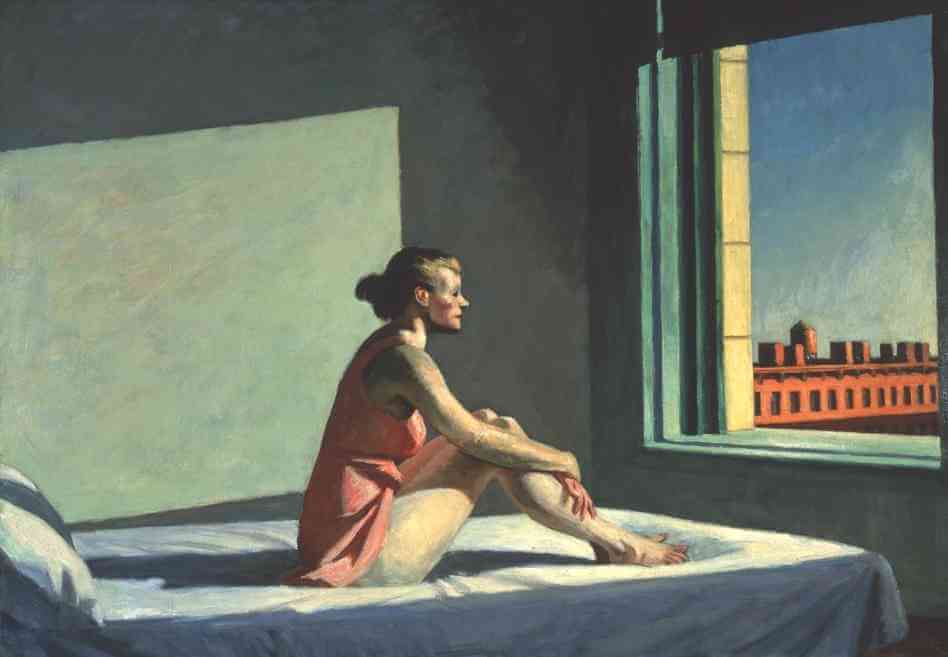
Art, texts of all kinds, all take on a new experience in a different light, from a different angle, from the ever-kaleidoscopic contexts of reception. Proliferating in this crisis of full isolation, I read this morning, is a burgeoning comparison with Edward Hopper’s paintings. Usually said to depict the isolation Hopper saw in modern life, today, these paintings take on a new significance to which we can all–sadly, pensively, beautifully, communally–relate. What would Hopper think if he were alive today? What would he be painting?

As writers, context of reception is scarce within our powers to control. We hone our texts in the hope that they will garner a close gaze, but we can control only the text itself. Anticipating what contexts of reception it might flourish in–perhaps that can help us craft the text from the beginning, but much always will be up to chance.
This morning, I sat at the kitchen table peeling several heads of garlic, to freeze for cooking later, a custom of my mom’s. My husband was still asleep. I’d had my tea and an hour of work on a short story. With garlic and a knife in hand, I started the audiobook again, Count Rostov rematerializing in a sluggish burst–I had to backtrack a few minutes to catch my memory.
I found I liked him more. I found I understood his penchant for the fineries of daily life and his careful keeping of a routine, including weekly visits to the hotel’s barber whether or not he needed a cut. I understood because these things have become relatable in a way I hardly ever expected they would be.

I’m confident now I will finish the book, and the lesson, my lesson that I take, is that each story can shine or wither depending on who or how or when it’s read. This I must accept, as I toil at my writing. I can keep the faith that at the right time, for the right audience, the meaning will be there.
Be well, be calm, and let us learn something from Count Rostov. We’ll get through these times as well we can. We’ll write and read and live and go on living. Best wishes for the week ahead.


