
In this third season of Star Trek Discovery, there is a lot to enjoy. A reimagined, post-Federation galaxy, the ever-imaginative CGI work, characters who are growing on me in this third adventure through space and time, and most importantly, Star Trek’s beautifully hopeful, human, redemptive storytelling in an age when so many shows seem fixated on the dark.
One aspect of the show I have found particularly interesting from a literary point of view is how it straddles the poles of episodic and serialized narrative to present a remarkably engaging storytelling. Today, let’s explore how this is achieved and how it might be relevant to our writing.
Narrative structure of TV series
It is helpful to think of two major organizational strategies that TV series can use: the episodic and the serial.
Episodic television
Most TV dramas of the twentieth century rely on an episodic structure. In this structure, each (usually) weekly installment presents a complete narrative arc, introducing a conflict at the beginning of the episode that is then resolved by the end. The next episode then begins a new conflict, making no reference to the previous.
Why the episodic structure is great
Episodic shows have the great advantage of a low barrier to entry for new viewers. A viewer can miss a week, start watching a show halfway through the season, or watch episodes out of order without confusion. These shows also function well as reruns, as a network can fill any number of available slots without having to commit to rerunning the whole season. For the above reasons, episodic shows are the mainstay of network television.
Another advantage of the episodic structure is the opportunity it gives the show to explore tangents, develop supporting characters, and experiment in ways that keep the show fresh. In Star Trek Voyager, a largely episodic series, Captain Janeway can be said to be the star of the show, but individual episodes regularly relegate Janeway to the role of supporting character or even antagonist, while another member of the crew takes center stage, forging their own developmental arc. Something like a multiple-narrator ensemble cast, these diversions from the norm make the world of the show more richly textured and allow us to connect with supporting characters in ways that are less possible in fully serialized dramas.

What doesn’t work well in episodic storytelling
But an episodic structure can also leave the audience wanting more. When the powerful emotion of an episode dissipates at the end, when the long-term consequences of characters’ actions almost never impact anything beyond the confines of that weekly episodic barrier, we can start to feel that we are reliving Groundhog Day again and again with no possibility for development. Or, in Star Trek terms, we might be stuck in a time loop.
Because each narrative arc is compressed into a one-hour-or-shorter chunk, conflicts can lack development. These episodes risk falling back on clichéd character motivations, skeletal plot that sketches out only the barest glimpse of wider implications, and contrived plot devices to leave things neatly resolved before the time clamps down.
Serialized shows
With the advent of VCRs that allowed the recording of an episode to be watched later, and far more in the current age of streaming, on-demand TV, heavily serialized dramas have grown popular. Like Charles Dickens’s serialized novels, an installment published weekly or monthly in a magazine, serialized TV presents one cohesive story arc over the course of many episodes.
Great payoffs of serialization
What the episodic structure lacks in development the serial drama hits bang on. Serialization allows an arc to be minutely developed. With far more total screen time than a feature film, serial shows more closely resemble novels in their methodical progression through a story, carefully revealing information at key moments, hooking viewers with cliffhangers and mystery that keeps us binging hour after hour.
Subplots too receive greater development here, as a thread can be revisited, explored from different angles, and intersected with the main arc in surprising ways. Serial dramas have a more sophisticated narrative arc that lends itself to more nuanced conflict, whose implications can be felt in multiple dimensions.
The challenges of serialization
TV networks have traditionally been far warier of serialized shows, which have a higher barrier to entry for viewers: if a viewer misses an episode, the story has progressed so much that they feel lost. Serialized shows cannot be reshuffled or cut off mid-season for reruns, and the complex arcs can frustrate viewers who want a simple after-work escape. See some interesting discussion of this phenomenon in action in this article about a British reboot of the episodic Law and Order, contrasted with the more serialized Lost.
Serialized shows also, paradoxically, can in some ways under-develop. The relentless march of the serial drama towards its final conclusion makes it less likely to pause to explore side-avenues, supporting characters, and thought-provoking implications of the ideas presented. Instead, sometimes these shows can feel like one action-scene after another, whose goal is never to relish the moment but only to move us on to the next episode.
Star Trek Discovery: the best of both worlds?
Significant room exists for blending episodic and serialized storytelling. Episodic shows often use serial subplots that lend some sense of connectivity to the storytelling without precluding the enjoyment of a single episode.
Serial dramas can break up their narrative arc into more bite-size stages of action that have some internal integrity. Shows can to some extent move between the two forms, a usually episodic show following a two-or-more-episode special serialized run (Star Trek Deep Space Nine famously did this in its Dominion War episodes among other parts of the series). Serialized subplots are common in many otherwise episodic narratives, as we watch character relationships evolve over time.
So it can be useful to think of serialization and episodic structures as poles on a continuum rather than strict categories. Star Trek Discovery, especially its second and third seasons, have charted this territory in some pretty effective ways.
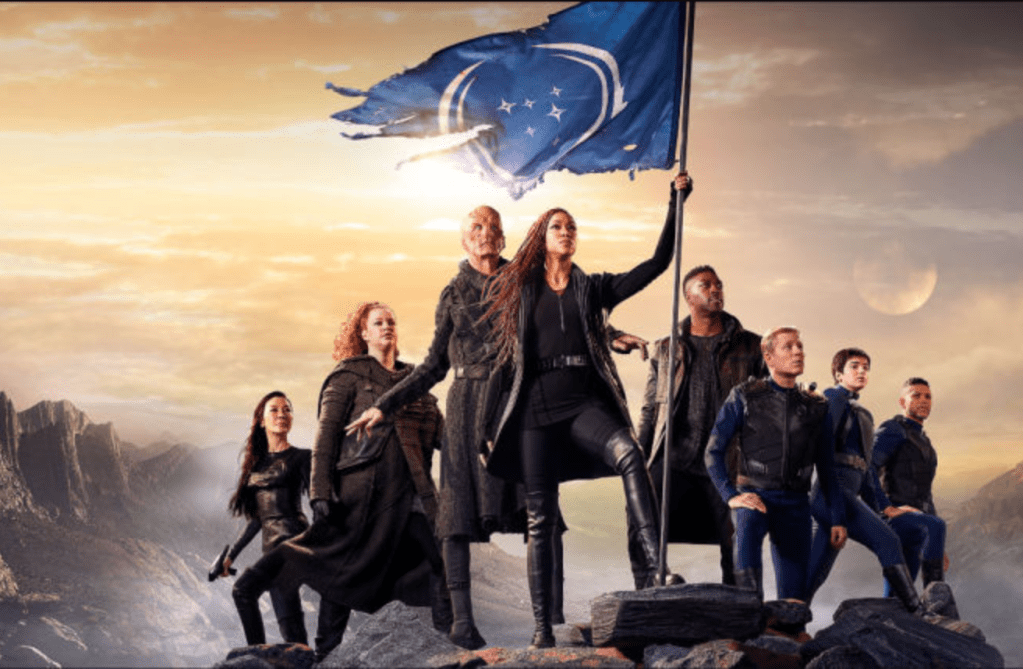
In this beginning to Season 3, the ship and its crew have been flung nine-hundred years into their world’s future and are trying now to navigate an alien, ailing galaxy while maintaining their bonds to one another and their principles as Star Fleet officers.
The season has a strong overall narrative arc, as the crew works to discover the cause of the fall of the United Federation of Planets. Each episode, then, forms one step along that journey. Here, I’ve traced a brief synopsis of each episode and linked it to the full-season arc. To avoid spoilers, I have only identified the main conflict(s) of each episode rather than their resolution. In case you, readers, are really concerned about any spoilers, I’ve made the text in the table below blend in with the background. Highlight it to read.
| Episode | Relationship to the full season’s narrative arc | Episode’s individual conflict |
| S3E1: “That Hope Is You, Part 1” | We are introduced to the future world in which the Federation appears defunct and the galactic community limps by without a stable source of dilithium, required for long-distance interstellar travel. | Arriving on an unknown planet, Michael tries to get the communications equipment she needs to contact Discovery. |
| S3E2: “Far From Home” | We learn more about the “Burn” that decimated dilithium supplies two centuries before. Discovery and Michael reunite. | After crash-landing in a hostile environment, the crew of Discovery attempts to repair the ship so that they can search for Michael. |
| S3E3: “People of Earth” | In an attempt to find what remains of Star Fleet and the Federation, Discovery makes its way to Earth. | Earth’s government refuses help to Discovery; meanwhile, hostile raiders attack. |
| S3E4: “Forget Me Not” | In order to access a buried message that may lead them to the Federation, Discovery visits the planet Trill. | Adira seeks to connect with the memories of her trill symbiont. Meanwhile, Saru attempts to reunite a crew whose morale is rapidly deteriorating. |
What I think sets Discovery apart from other shows (although I imagine others are out there that make similar use of episodic and serial structures) is the deeply intertwined nature of the individual-episode and the whole-season arcs. The season arc keeps us ready for the next episode; there is no drop in energy here, and this will sustain viewers throughout the season.
However, there is still a feeling of satisfaction at the end of each episode as that individual conflict is resolved. This gives the show the chance to slow down and appreciate the emotional impact of the events we’ve seen, which can be lost in heavily serialized narratives.
Discovery has also gained the episodic benefit of the opportunity to shift focus to supporting characters, as Episode 4 makes clear with its close focus on the new character of Adira Tal.
How is this useful for us as writers?
If we are not writing television screenplays, we may wonder why this discussion is relevant. I’ll offer here a few brief reflections.
Although long-form fiction tends to follow one cohesive arc, episodic structures within longer works can be used effectively, whether dividing a novel into chapters, or going further to consider the novel as something closer to a collection of short stories. I think there is some interesting ground for experimentation here, a collection of integrated short stories that function as one chronological narrative but can also be read independently. This could provide greater range for stylistic experimentation within the confines of a single work.
It is relevant too to consider how TV series engage and sustain their readers’ interest, because we as writers of other genres must also be asking such questions. Considering how subplots and the arcs of supporting and major characters interact with the fuller plot can help us identify where the energy of a narrative might be struggling or how we could better integrate these elements into a cohesive whole.
I’m excited to see where things go with this series, especially after it was recently announced that Season 4 of Discovery would begin preproduction soon!
What do you think of episodic and serialized TV series? How else might these ideas be relevant to our writing?
Best wishes for the upcoming week,
Jimmy



I appreciate your posts so much because they are very informative for me as an English teacher and as a TV drama series lover!
LikeLike
My youngest daughter got me hooked on Babylon 5, which I then binged. That’s another show that has multiple arcs. There’s a five-year arc, each season has an arc, and each episode has an arc. Well, I suppose I could take that further, since Donald Maas says each scene, each conversation, each choice needs to have a conflict and resolution. I absolutely agree that writing stories and novels can take lessons from screen, television, or stage writing.
LikeLike