
Let me begin this post as clearly as I can, knowing that the later paragraphs will invariably (for I have already written them and know) diverge, get muddy, lose themselves. I’ll be clear:
Good writing must be readily understandable. Clarity of expression should be a writer’s foremost goal. Artistry of language, implied meaning, symbolism–these things are necessary and good, but only insofar as they do not disrupt clarity.
Today, we will discuss why clarity is important, but also why it is so often lacking in our work. We will complicate the idea of clarity as well: what does it really mean to be clear? How can it be achieved? I hope, in the end, to leave us with a clear way forward. Let’s begin:
Why clear expression matters
Writing is an act of communication, that is, the transmission of a message. If we want our writing to be read by other people, then we have to make that message clear.
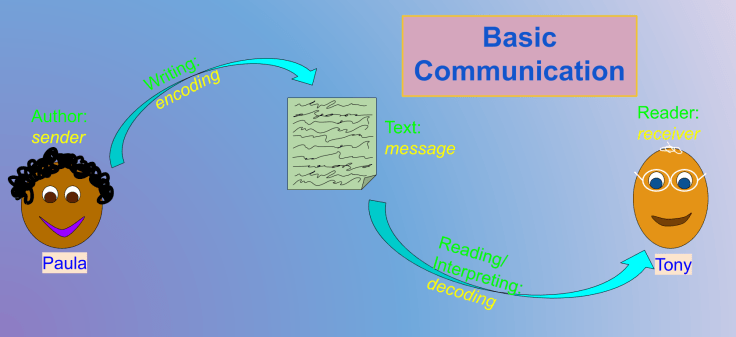
In the above illustration, if the ideas encoded into the text (the message) by Paula are substantially different from the ideas decoded by Tony, then communication has perhaps not been successful.
But what do I mean by message? In an informative or persuasive piece of nonfiction writing, the idea of message requires little explanation. The message is the idea that I have in my mind that I am attempting through this strange form of mind control to transfer into yours. In this blog post, for example, the message is that you should prioritize clarity in your writing, and if we get to the end of this post and that message is not in your mind, for you to carry with you and either utilize or argue against or discard, then my text has failed.
In other genres message is more slippery. In fiction, while some would say that a theme or didactic message is always discernible in a story, I’m not so sure. Stories often exist (at least from the writer’s perspective) purely as stories to be told. In this case, however, we can say that the message is the story itself, and clear communication of that message means that the reader is able to follow what is happening in the story and could retell it to others with reasonable fidelity.
If the text’s purpose is to tell the story or express an idea, and if readers come away not understanding that idea or having experienced that story, then at a fundamental level we have failed.

Counterargument: leaving things open to interpretation is good
In the reader-centered field of contemporary literary studies, the focus is often on what meaning the reader makes of a text, irrespective of the author’s intentions. “The author is dead,” we are fond of quoting. But we as authors ourselves are anything but dead! We are breathing and kicking and biting. It is true that once the text leaves our hands each reader may make of it what they will, but until it leaves our hands, we are working to anticipate those readers, designing the text to achieve a particular effect.
If part of our vision as writers for a particular piece is that it can be interpreted in multiple ways, so be it. In that case, the piece should be designed to make these multiple interpretations possible and plausible. They should pop into existence by virtue of the text’s construction. But to write without clarity and then fall back on the defense of multiple interpretations, this is laziness and face-saving.
My first publication, dearly as I love it, falls horrible victim to this kind of lack of clarity. I wrote “Parable of the Earth’s Crust” in the flurry of a vision. I was retelling the geological and biological and psychological history of the earth, de-centering humans from the narrative. My goal was to cast humans as only one piece of the greater whole, the earth itself, to focus on the earth’s crust as the basis of everything and humans essentially as pieces of that crust with some properties different from the rest.
I was honored to find a publisher for the piece quite quickly. Then some people read it, and not a single person I spoke to had the vision I had planned. Let me be clear: people had brilliant ideas. Most of them involved oceans, some truly rich interpretations of the bread and dandruff in the piece. Of course, these things I had intended as metaphors. All of them. And while I love these myriad interpretations and was honored that something I had written had inspired such leaps of thought, at the level of my original vision I failed to communicate. The message went in directions I had not anticipated.
Perhaps it’s too harsh to use the word fail here. After all, I think I successfully expressed the feeling, the whimsy, the freewheeling mental attitude that consumed me as I wrote. And the visions created by readers are beautiful in their own rights. But there was also a lot that never made it through. What can I learn from this?
Counterargument: I want my readers to think
Another defense of unclear writing (one I have heard and also used myself) is that writing that is straightforward becomes boring. Readers have no reason to think about the text, because everything has been explained. I have two responses to this argument.
First, unclear writing is more likely to deter readers from reading at all. Without a compelling reason to think deeply in order to make sense of a text, most readers will click to the next page, or toss the book back onto the shelf. We often say of a confusing text, “I got lost,” and the meaning here is double: we as readers lose track of where we are, and the text itself has lost our readership. The barrier to entry was too high. There wasn’t clear incentive to keep reading, and so we stopped.
Second, I would ask, what do we want readers really thinking about? We confuse all thinking for useful thinking, and we substitute the act of deciphering a train of thought from the deeper thinking that happens when a story brings up meaty, philosophical, or otherwise important issues that provoke thinking about life itself. In the example of my “Parable of the Earth’s Crust” discussed above, I hoped that readers would think about their relationship with the rest of the planet, about how the human mind works, about the past and present and future of the universe. Instead, most people who read it were thinking, “What?”

Counterargument: ambiguity is engaging
I argued in one of my series of posts on conflict that it is mystery, a desire to find out more, to answer the reader’s questions, that is the principal driver of readers onward through a story. Making readers curious is thus an essential task of writers, from beginning to end of a story. What better way to create that curiosity, we might say, than ambiguity.
Here is where we get into the question of proportion. Yes, indeed, we cannot tell everything. Yet there is a difference between creating questions in the reader’s mind and lack of clarity. We should intentionally reveal or not reveal, rather than muddy the waters so much that readers are lost. In order to become curious at all, readers need enough grasp on what is happening in the story. If they don’t, they will not care.
What is clarity?
What makes some texts clear and others garbled? It isn’t always as clear as we might imagine.
Clarity and audience
Clarity has a lot to do with audience. Readers with significant experience reading and interpreting literature will find clear many things that others do not, and readers of a higher age or education level or language proficiency will tend to find more challenging texts clear. Readers who love science fiction may be more prepared than others to tackle a complex, imaginative society. Readers with more knowledge on a particular topic will find texts on that topic more accessible.
From the get-go, then, our quest for clarity as writers has to pay attention to our target audience, providing the explanations that are necessary for those readers but without pandering so didactically to them that we turn our audience away for boredom.

Clarity and multiple levels of understanding
We also might say that a text has multiple potential levels of understanding, and these may be clear to varying degrees. I bring to mind here children’s films that contain subtle references to engage parents, either missed completely or else confusing to their child target audience.
This can also be true of great stories that, beyond their basic-level plot, carry a deeper allegorical significance. Toni Morrison’s Sula is a great example here. It might be read at a basic level, the story of two women’s lives and how their friendship changes throughout the years, but read more deeply, the novel explores the darkness of love, its entanglement with hatred, the fear of change, etc. Sula is clear, because it can be accessed meaningfully at a particular level, and this then truly does invite readers to think more deeply and access the story closer to its core.
What is clear to you may not be to others
I return to my own fiction, the creature I am stitching up and sending out into the world, my baby, my darling heart. Sometimes in revision, I do my best to reread with the eyes of someone else. What will the rest of the world see when they read my story? I often think that I am guilty of a kind of literary solipsism. I have written in what amounts to my own private language: great swaths of symbolism, scribbled over with extra metaphors, words there sometimes as much for the rhythm as the sense, and in my own mind, these make perfect sense. I recognize that to others, they will read it in confusion, if they read at all. This is why working together with beta readers and critique partners is so valuable: they have the eyes that we lack. They can point out where things grow unclear.

Last thoughts
Students in my literature courses are often frustrated by poetry. I bring in a brilliant piece, like Sylvia Plath’s “Tulips.” We read it aloud a stanza at a time. I ask the students, “What is happening here? What is the speaker in the poem experiencing?” And we begin the slow and agonizing process of birthing out the meanings of the lines. Quickly, they find the hospital in the poem. They understand that the speaker has received some flowers and that she does not want them. They insist in the first line that the poem takes place during winter and purse their lips when I tell them the winter is a metaphor.
Once when we reached the giant white eyeball propped between pillow and sheets, a student asked me, “Why didn’t Sylvia Plath just say what the meant?” I smiled. I gave some interesting and probably unsatisfactory explanation, I am sure. But the question is a good one.
For Plath, I think often the images and the shocking language and her personal biography are enough to get readers curious. These lures are enough to start the process of interpretation, and that slow discovery of the rest becomes a worthy reward. But in most cases, a lack of clarity is a closed book, and even as we seek artistry and beauty and personal style in our language, we must keep our eyes firmly on our end goal of communication.
I hope I have made myself clear today. What do you think? What is clarity? Does it matter as much as I am arguing? Are there places where clarity is misplaced? I am still wondering.
Best wishes for the week to come,
Jimmy