This last week I participated in an online short story course. One Story‘s Write a Short Story with Hannah Tinti was an engaging, entertaining, but most of all practically useful one-week course, though which we explored a basic structure for short story writing. This was the first class I’ve done with One Story, and I ended up having a really positive experience and would certainly recommend exploring their course offerings for the future.
One small but impactful idea that I learned in this course was that of using in our stories the various shot types that we might recognize from film. Film of course draws much of its narrative structure, technique, and concepts like character and plot from the older art of written stories, and cinematographic language in turn has become a great wealth for fiction writers. Today, let’s explore how using these shot types can bring clarity, action, and emotion to our writing.
Writing as cinema
Let’s begin with the basic metaphor of a written story as a film. We might say that the reader is watching a movie, and the writer is choosing where to point the camera and how to establish each shot. As the director of the film, we have myriad choices about what to show our readers and for how long, what to emphasize in the shot, what to cut, when to end the scene, and when to linger for a long time close up on one detail.
The choices we make will impact the reader’s experience, impacting the way they understand what is happening and how they feel about the characters and scenes playing out before them. If we can make our decisions strategically, we can construct a reader experience that engages and moves readers in meaningful ways.
Long shot, medium shot, and close-up
The long shot, medium shot, and close-up form the core of the filmmaker’s toolbox (you can read in greater depth about these and other shot types in this blog post by Carly San Filippo). Each is used for a particular purpose, and each impacts viewers in a particular way. Let’s explore!
Long shot: clarity
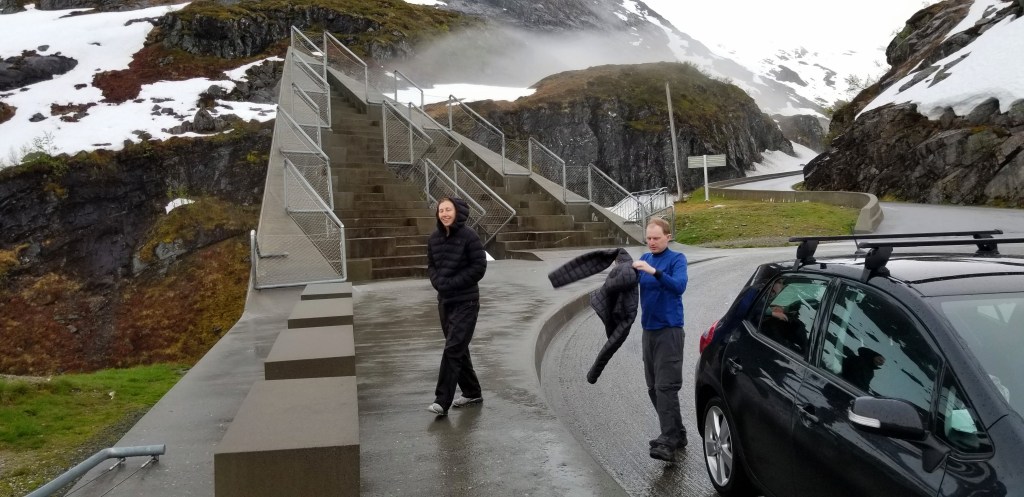
A long shot steps back from the subject, showing clear context for the setting around them.
Why are long shots useful?
Long shots in fiction help readers know where they are situated, establishing the setting and the situation in which the characters find themselves. Importantly, we can say that even though the long shot is zoomed out and shows us a lot of the surrounding place, the focus of the shot is still on the characters. When people become so small in an image that the focus can be said to instead be the setting itself, we would call this an extreme long shot.
Long shots create a sense of distance between character and audience. Typically, filmmakers and authors will use long shots in small quantities, effectively establishing setting before moving into the more standard medium shots that show us the action of the story. But a writer might choose to spend more time in the long-shot arena if they want to establish in readers a feeling of detachment, or the smallness of characters in the face of the world around them.
At their core, long shots are used to establish clarity for readers, forestalling the disorienting confusions about basic story details and thus helping readers feel grounded at the start of the action. Long shots can be most useful at the beginning of a story to guide readers in. They might also function well as transitions between scenes.
What does a long shot look like in fiction writing?
To build an effective long shot, ground the characters in their setting. Long shots establish the facts so that readers are oriented in the world of the story. It is worth noting that, in addition to physical setting, the long shot may establish other contextual details beyond what can be achieved with an actual camera image. At the same time, the long shot is not a visceral scene description. We certainly can and perhaps should describe settings in detail, but we will come to this more in the close-up section below.
Let’s take a look at a brief example of what a long shot might look like in writing. I’ve written the following based on the image above:
Late in the evening, Taren stopped the car at the high point of the Gaularfjellet, and he and Carrie emerged into the cold wind of the mountain. Three hours of snaking road behind them, another two to go on that mid-summer night that was not night because the sun stayed hovering even then at 10:00pm, they laughed and reminisced as they pulled on their coats and wandered to the lookout point.
The following contextual details are established quickly and clearly, although none of them is developed in great detail:
| Place | Lookout point on the Gaularfjellet mountain |
| Time | 10:00pm on a mid-summer night |
| Setting description | Cold wind, snaking road |
| Situation | Two characters partway through a long drive |
| Tone | The relationship between the characters seems positive (they are laughing and reminiscing) |
Medium shot: action
Medium shots bring us closer to characters, and these form the real bread and butter of a story. We used medium shots more than either of the other shot types.
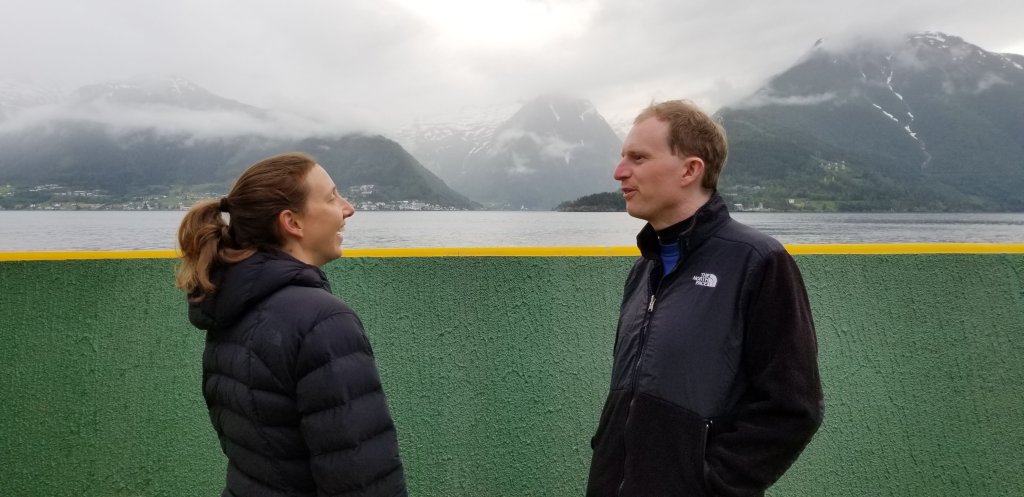
This medium shot was taken on a ferry over the Sognefjord. The focus is tighter on Carrie and Taren, allowing us to see the action playing out between them.
What do medium shots give my story?
The bulk of the writing in a story comes in medium shots, which show us characters in action, including dialogue and interactions between multiple characters. Medium shots are therefore key in advancing the plot and developing the movement in the story. If stories are about change, the medium shots are the key vehicle that bring us through that change from beginning to end.
Importantly, the focus in a medium shot is not so close as to slow the pacing of the story; these are not the deeply emotional detail that we will find in the strategically-placed close-ups. Medium shots are the default tool in our story writing.
What does a medium shot look like in writing?
Note in the following example, based on the picture above, the focus on character interaction without becoming too mired in detail:
Carrie leaned against the front rail of the ferry. "I hope we drove onto the right boat." She gestured back at the dock, where a second ferry was now loading up with cars. "Who knows where we're going to end up."

Taren laughed. "Well if we didn't, it's just an extra six hours to get around the other arm of the fjord. No big deal."

"That's the adventure, isn't it."
Close up: emotion
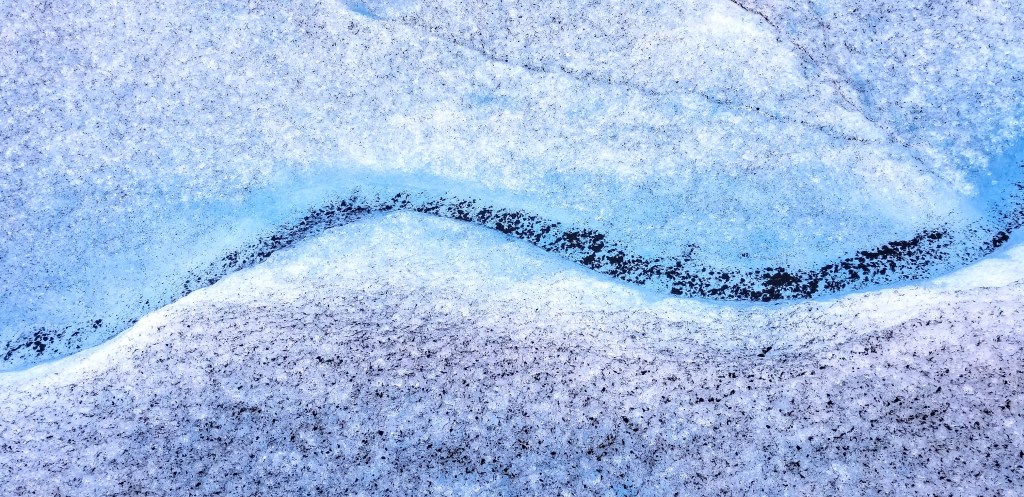
At key moments, a close up can bring readers into the emotion of the story, showing the significance for characters.
Why do we include close ups in our writing?
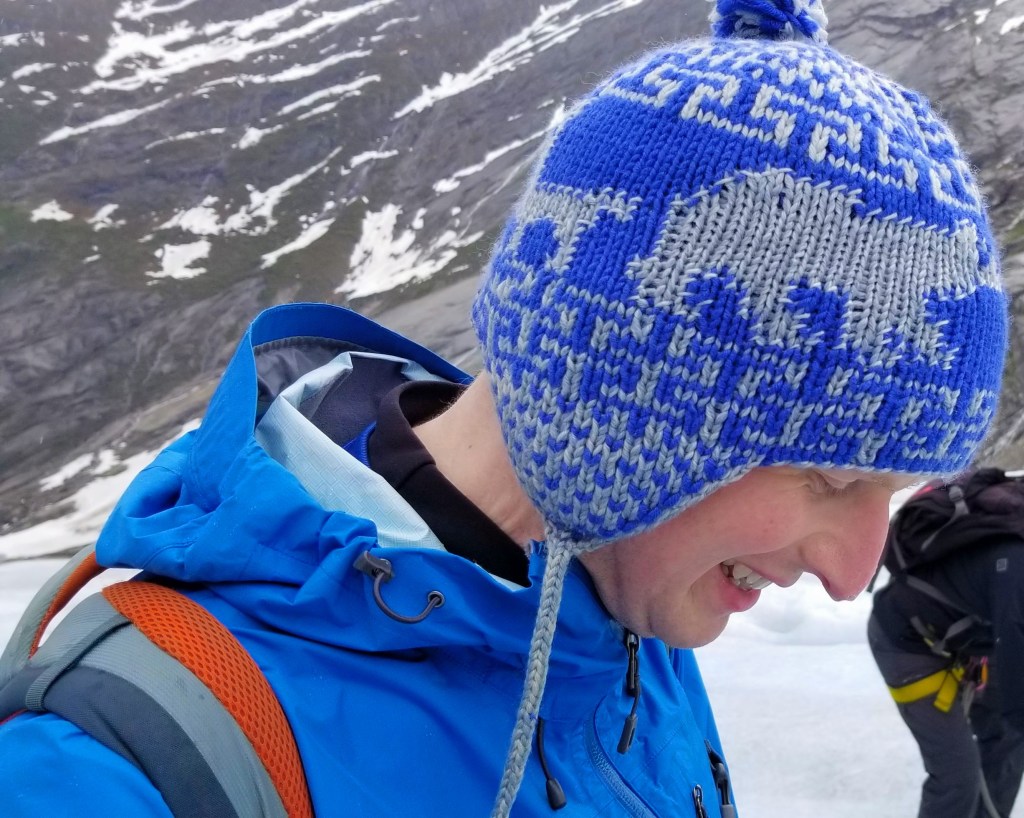
Close-up shots in film usually focus on a character’s face and show the emotional impact of what has happened. In writing, we use strategically-placed sensory details to convey these emotions and build empathy with readers. Close ups carry the emotion of the story by slowing the pacing and allowing moments of reflection.
Sometimes in our efforts to write vividly, to follow the common advice of “show-don’t-tell,” we overdo the close ups. The impact in these cases can be a slow-moving scene, overwritten, laborious to read, and ultimately without the impact we desire. Instead, we should choose our close ups carefully and deliberately, highlighting those details that are worth zooming in on to advance the themes and emotions of the story.
What does a close up look like in writing?
Close ups come with imagery: the reporting of a vivid sensory detail. These close ups may focus on the character themselves, or they may zoom in on a detail of setting or an object that functions symbolically to convey emotion. Any of the five senses can work here, so it is worth considering all of the sights, sounds, smells, tastes, and sensations that characters are experiencing.
Here is a short example of what a close up might look like, drawing from the image above:
The surface of the ice glowed blue. Rough, strewn with dirt and sand, Taren watched in awe the channels of cold meltwater coursing fast over its surface.
Putting them all together
Long shots, medium shots, and close ups come in quick succession in a story and blend together to form cohesive pieces of writing. A particular shot may be used only for one sentence, or it may expand to develop an idea.
As in film, we zoom in and out strategically in order to guide readers’ experiences and create the balance of effects we are seeking: a grounded setting, movement in the plot, and moments of emotion that work together to move readers. Below, I’ll write a short piece that brings in the three shot types, color-coded for clarity: long shots, medium shots, and close ups.
Carrie stared out at the vast ice of the Nigardsbreen, fissured with its deep chasms. Roped together to the guide and to the other tourists, she stepped forward, and her crampons gripped the ice. "How does the glacier move over the ground?" she asked. "How can ice 'flow'?"

"It's the pressure," the guide Gurratan said over his shoulder. He stepped easily over one of the narrow chasms, and one by one the tourists steeled themselves and followed. "The weight of the ice pressing down on itself makes the ice near the bottom turn fluid, and so over time it can flow like a liquid over the rock."

Carrie imagined that great pressure, this great mass of ice, forty meters thick Gurratan had told them, bearing down, crushing itself into the stones. In those dark and quiet places under the ice, she imagined that ice pressing hard against the rock of the mountain, grinding it away over millennia, scraping dust up into the body of the blue ice mass.

"How long before it's melted completely?" On top of the ice, she watched a rivulet of meltwater, carrying dirt along like a snaking river that dropped into one of the chasms, disappeared. She could hear the hollow pattering of the water as it fell away into black.
In the above example, I’ve moved between the shot types to try to shift readers towards the awe of the glacier, as well as the sadness of its slow depletion. This might then open into another scene as the story develops.
Final thoughts
Writing and film can learn much from one another. Using long shots, medium shots, and close ups strategically can help us move our stories forward, avoid confusion, and highlight emotionally significant events for readers.
This paradigm of camera shots is related to the concepts of scene and summary, and the skills of pacing, imagery, and dialogue are all intimately involved in its execution. What way of thinking about focus and pacing do you find most useful? How else might we think about these camera shots in writing? I would love to hear your ideas.
The school year now has ended. On Monday, we will be leaving Norway for summer travels, to Italy and then home to the United States. Best wishes for the coming weeks, and happy writing,
Jimmy


