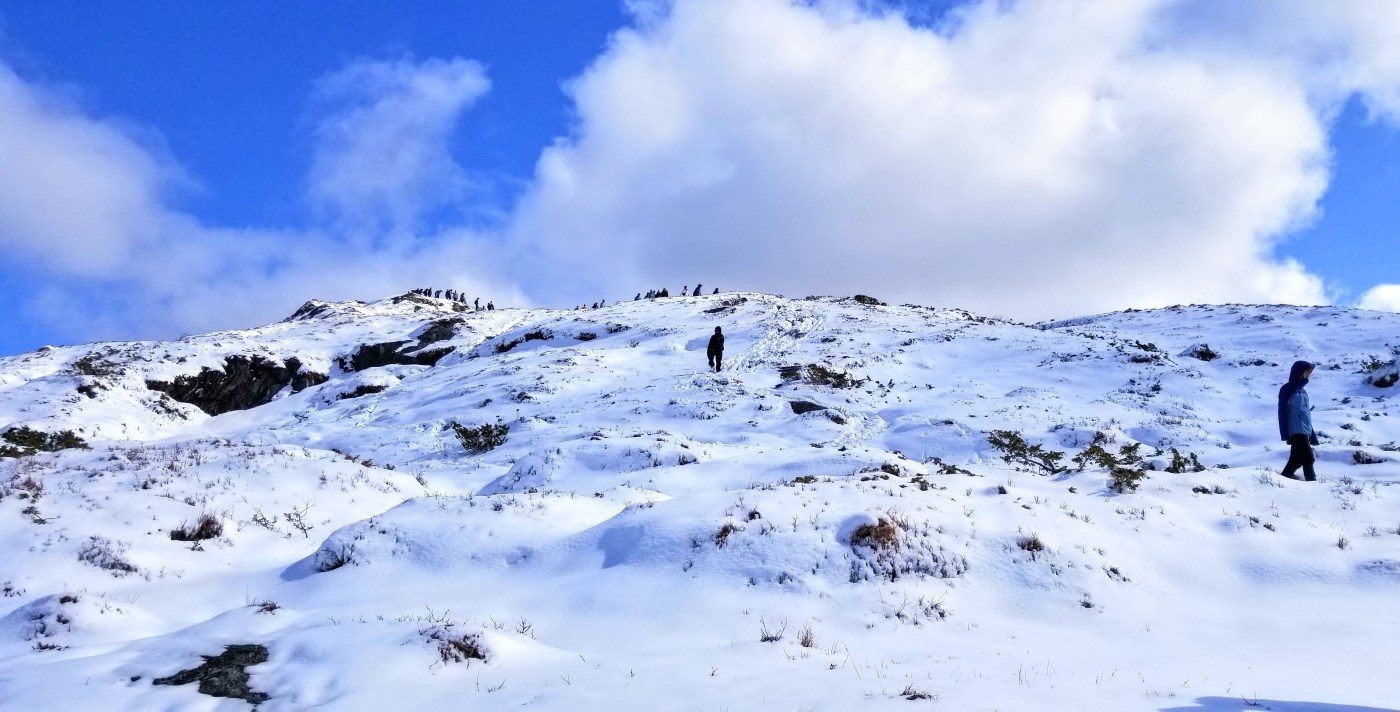
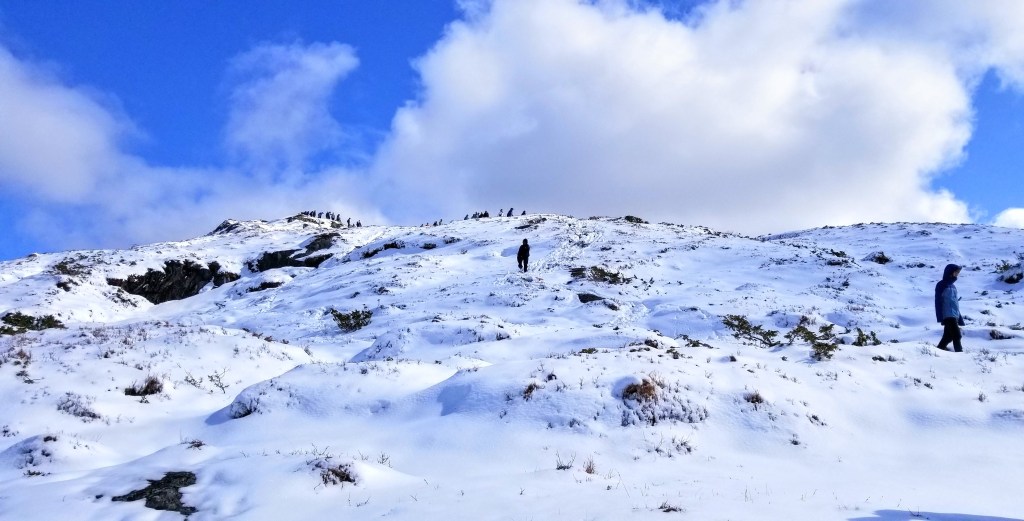
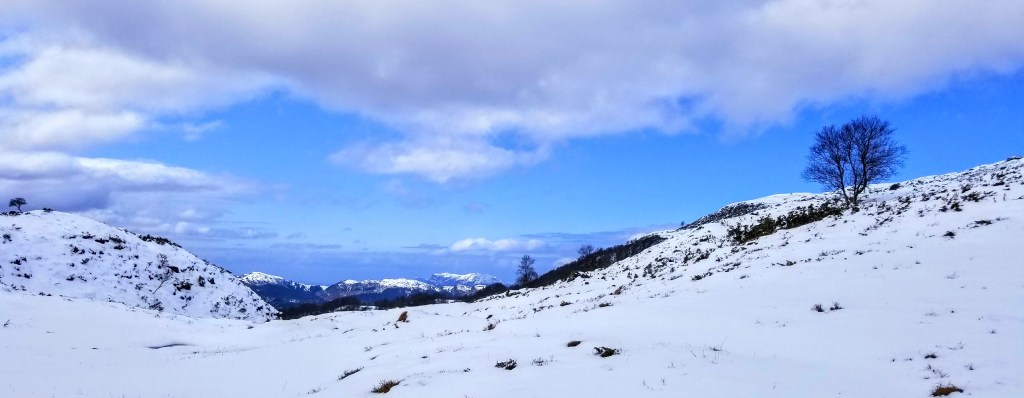
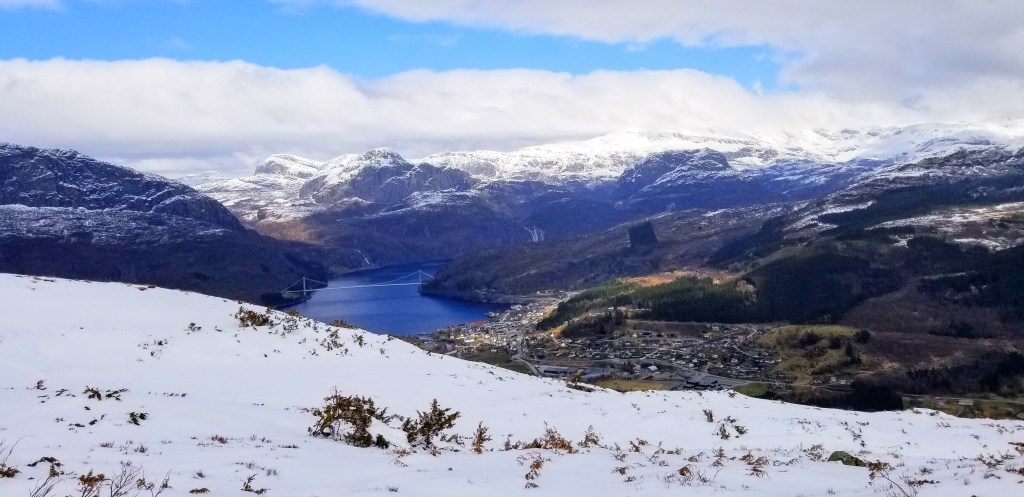
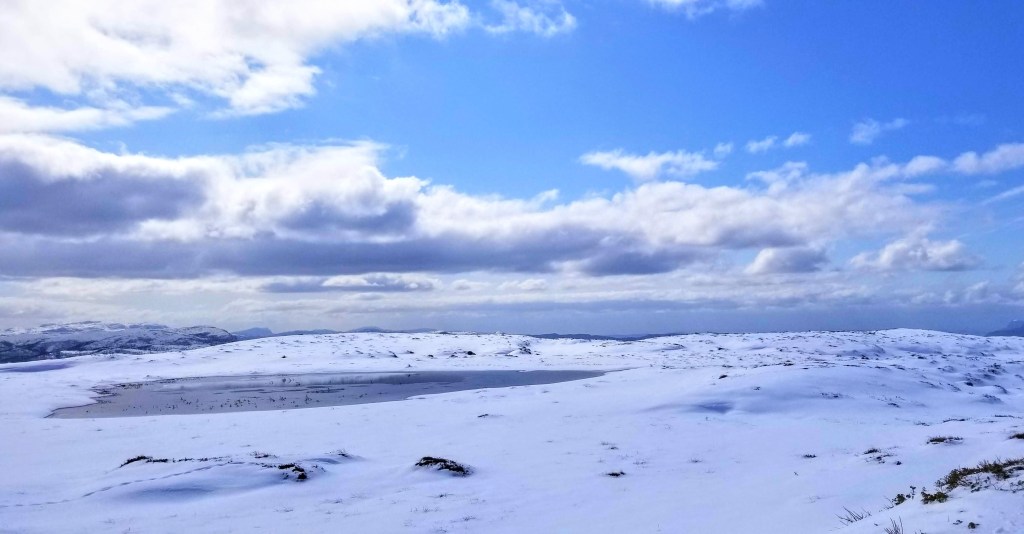
On the first of May this year, Labor Day in Norway and around much of the world, the first-year class took its annual hike up the local mountain, Jarstadheia. The hike took us up 584 meters into thick snow–more than a foot along the top plateau. We formed a winding column of sixty or seventy students and teachers. Spontaneous snowball fights, hot chocolate at the summit, and by the end everyone’s shoes were soaked with the mud of the lower slopes.
Climbing a mountain is a common metaphor for a story. Freytag’s Pyramid and other models of dramatic structure are often drawn as mountains in which a conflict’s rising action brings readers to a climactic turning point at the summit. The rise of the mountain symbolizes the direr and direr situation for characters and thus sets up the increasingly tense experience for readers.
Paradoxically, in a classic instance of it-has-to-get-worse-before-it-gets-better, it is through this worsening situation for the characters that they approach the climax, which contains the potential for solution. Characters must brave the mounting terror in order to reach the resolution on the other side. We say, the only way out is through.
Shifting focus in my writing
In the last year, my focus has been mostly on short stories. This work has been teaching me a lot about story structure, character, and language, but it’s time now I think to return to the novel I was working on before that. That novel has been alive in my mind over the last year even though I have not been actively writing it. Its bones have been percolating and developing. I think I am ready to return to it now and begin work towards another draft.
The challenge I was running into with the novel previously was this: its first quarter felt wholly crystallized; I felt a bit of clarity about the ending. Everything in between, however, was a chaotic squiggle. I had no idea how I would bridge them! I found myself writing aimlessly, hoping the answer would open before me. I produced several interesting scenes, but still without clear direction, I put it aside. For the time being, I gave up.
Returning now, and with the broader perspective of this time away, I have decided to try a more holistic approach to outlining. Before I begin rewriting, I want to have a solid grasp on the whole story. Therefore, I resurrected a technique I had first used four or five years ago with an earlier novel: Randy Ingermanson’s “Snowflake Method.”
What is the Snowflake Method?
Ingermanson’s idea of the Snowflake Method is based on fractal geometry. He suggests the writer starting with something small and (a bit deceptively, because writing a good one is quite difficult) simple: a one-sentence summary of the novel.
Then, through a series of steps, the writer expands that single sentence into a paragraph, then that paragraph into character sketches, then the material so far into a larger summary, and on and on until a highly-detailed outline, scene by scene, takes shape.
Ingermanson suggests that using this top-down strategy can save us time and anguish, because it can reveal before writing the draft where weak points in the story might be. “If the story is broken,” he writes, “you know it now, rather than after investing 500 hours in a rambling first draft.”
I can feel that. I’m laughing at myself. So now, I am in the process of fixing and reshaping the story. My snowflake is crystallizing.
Character synopses as a tool
One of the pieces of the Snowflake Method that has been surprisingly illuminating has been its close attention to character. After writing an initial plot summary, which generally follows the perspective of the protagonist, Ingermanson has writers flesh out major characters, identifying for each their motivation, goal, conflict, arc, and then writing a one-paragraph summary of the character’s storyline.
For me, I’ve been expanding these one-paragraph summaries into much larger summaries from the beginning, and what they have become for me is a powerful shift in perspective. I have thought ad nauseam about what my main character, Sam, experiences, and other characters have been developed, but what I realize now is that I have ultimately been looking at these other characters as tools to give Sam the experience that I need him to have.
What the Snowflake is challenging me to do is to really think of these characters as human beings in their own right. That is, how does the story really appear from their perspective? This is powerful. It helps me recognize where a character’s actions are contrived, what they are feeling at various points in the story, and what they really care about.
What I find is that these characters begin to develop their own rising action-climax-resolution structures, superimposed on that of the larger novel. In theory, I could tell this story from the voice of any of them.
These characters’ stories weave through one another, the goal of one providing the conflict for another. As they take on greater life, I can begin to see the heart of the story I am telling, which really is larger than just one person. I hope that when I begin redrafting, this understanding will help me craft something more compelling and alive.
Backwards design
Ingermanson’s method reminds me a lot of a concept that is at the heart of my work as a teacher: Backward Design. Using a Backward Design approach, a teacher begins lesson planning not with an activity, but with the learning goal. We decide at the outset, what is it that we want students to be able to do. With that defined learning goal in hand, we then work backwards, designing activities and finding resources that will bring our students to that goal.
The Snowflake’s one-sentence summary of the novel is that goal. Every developmental step of the fractal shape expands on that single sentence, is in the service of that sentence, so that by the end, we have a step-by-step roadmap towards telling the story we want to tell.
Final thoughts
I imagine some writers would find Ingermanson’s structure stifling. For me, though, more a plotter than a pantser, it is providing much-needed clarity and direction. Here, again, is the link to Ingermanson’s article. Perhaps you’ll give it a try.
What do you think of outlining? Have you tried the Snowflake, or are there other particular outlining methods that work well for you?
I expect I’ll be hiking up a few more mountains this spring and summer, hopefully with a bit less snow. As I do, maybe I’ll be thinking about these stories I’m plotting, the different characters climbing their own mountains, or each climbing the same mountain on a different trail. What are we going to see from the summit?
Best wishes for the coming weeks,
Jimmy


Thx, Jimmy. I liked the juxtaposition of the student-teacher hike up the mountain and the structuring of a novel. Good luck on resuming the writing of your next novel.
LikeLike
THANK YOU. I desperately need methods for outlining.
LikeLike
I am very much a planner, but when I tried the snowflake method (many years ago) it just didn’t feel right. I think I tend to come at a story from several different directions, depending on which elements got me excited about it in the first place.
I’ve also come to accept that my process will often feel inefficient. The way I tackle a book will be different from the last, because I’m a different author, and each story has different needs.
I hope your time away from this book will help you find those missing connections to make it through the difficult middle!
LikeLike