This last week at school was a different theme: no classes, the first years busy with a first-aid course and Model United Nations, for which they dressed their best and debated the future of our world. The second-years, meanwhile, had project week, and my husband and I led a small group in a three-day journey through spoken word or slam poetry.
It’s been years since I spent much time with this genre, although I used to do it for a few days with my creative writing students in Minnesota. I was reminded this last week of its power, emotion, the personal depth of it. In this post, I’ll walk through the resources I used–feel free to take and run with any of these, for yourself or for others you are guiding.
What is Slam Poetry?
In the distant past, poetry was never written down. Poems were composed, memorized, and performed, and heard all orally, communities around the world sharing oral literatures this way.
In the Western countries of the present day, poetry is more often thought of as a written genre, something we pick up on a quiet afternoon or explicate in school.
But poetry read aloud, experienced, and performed, as is the central feature of the umbrella-genre Spoken Word, is really more a returning to the genre’s roots than it is an innovation. Poetry and other literature connects us to one another, and spoken-word poems are a great vehicle for testimony, as marginalized voices rise up to share their truths, as all people dig into the recesses of their minds to identify what they may not have shared out before.
Slam, a sub-genre of Spoken Word, is usually performed as part of a competition. Poets gather in a coffee shop or bar, each heading to the microphone for 3-5 minutes. The audience is loud: they snap, voice out support like at a church service, and it is the audience who chooses the winner of the slam–traditionally five audience members chosen at random serve as judges.
What do we learn from Slam Poetry?
Why is Spoken Word or Slam Poetry valuable? What do we learn from the experience? In my experience, the deepest value comes from giving voice to the unvoiced. Slam Poetry asks us to take something confessional, personal, or something about which we are passionate and set it free in the most direct terms. For many people, this directness is unnerving, even frightening.
Slam Poetry helps us…
- to get in touch with our emotions, passions, fears, and opinions;
- to practice public speaking, perhaps the most immediate, personal form of publication;
- to engage in political or social discourse, contributing to the essential societal conversations about justice, identity, and other issues;
- to exercise writing skills of versification, metaphor, rhythm, sound devices, imagery, anecdote, repetition, and others;
- to build community by showing support for one another’s perspectives, being honest with ourselves and those around us;
- to witness the truth in our fellow human beings, especially those whose voices have traditionally been marginalized.
Step 1: Learning about Slam Poetry
We started with some exploration. Students brought their headphones and computers, and we spent an hour browsing Button Poetry’s YouTube channel. In preparing this workshop, although I did find some other compilations of recorded poems, Button Poetry had the widest range and the greatest number. They upload a new video each day, and many of the poems have vetted subtitling, which is helpful for English language learners.
We asked students to choose one poem from their exploration to share out with the group. We watched these together and discussed. Here are a few that particularly stood out from our workshop:
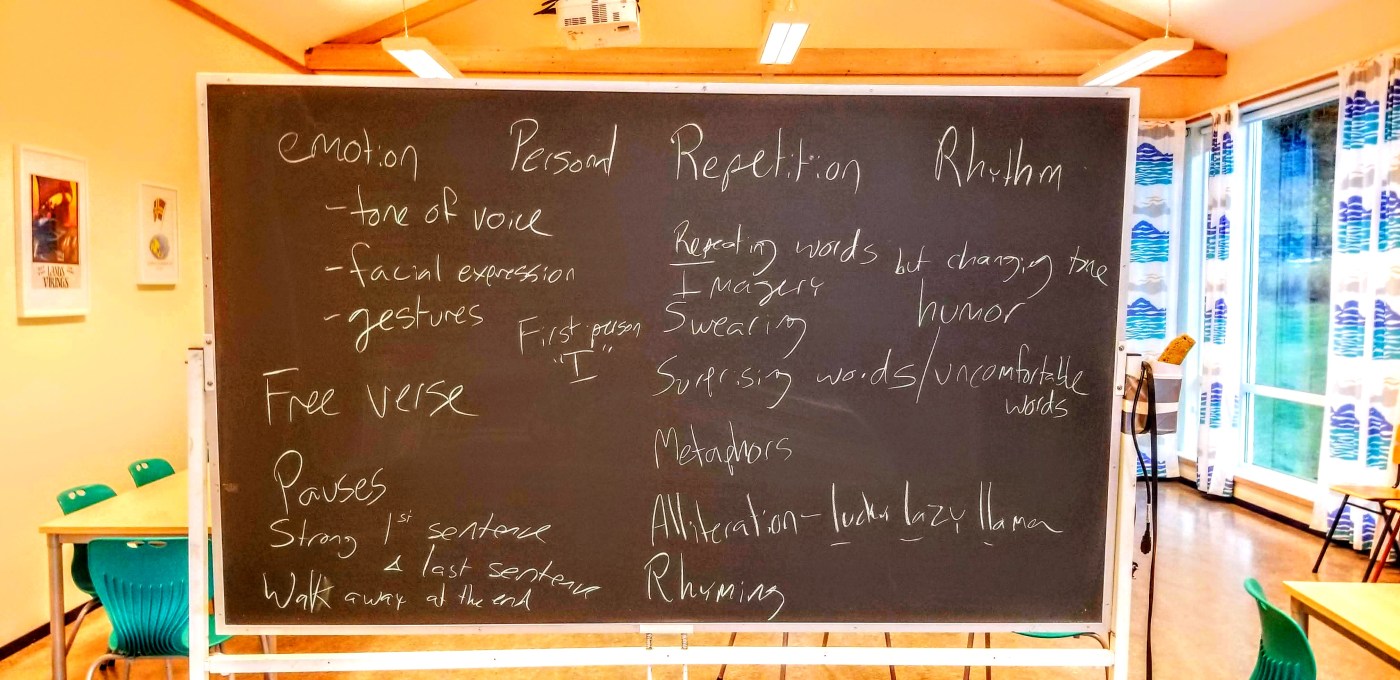
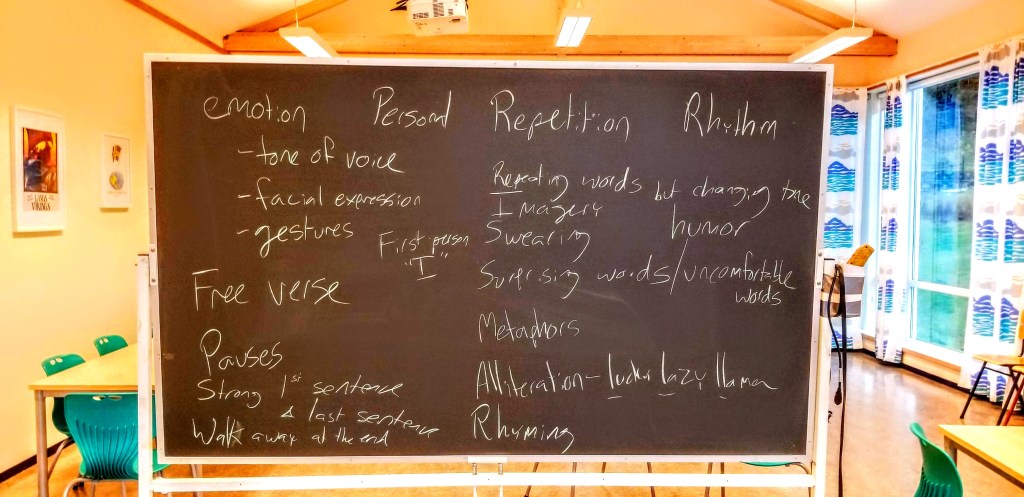
With each video we watched, students added to a list of techniques they saw being used. These ranged from literary elements like alliteration and metaphor to performance technique–facial expressions, pauses, gestures, and tone of voice.
Step 2: Brainstorming through Writing Prompts
Interspersed within this learning, we began asking the group to freewrite on some prompts to generate potential topics. At transition points (after a break, after lunch, at the end of the first day of the workshop), students wrote for ten minutes about a prompt selected from a short list.
Here are the prompts:
1: Something Wrong
- The most unjust thing I’ve ever seen is…
- Something I think is wrong with the world is…
- Something that makes me really angry is…
2: Truth-Telling
- Who I really am inside is…
- The truth about how the world works is…
3: The Way Forward
- The toughest lesson I ever learned was…
- The best piece of advice I ever heard is…
- If I could tell something to future generations it would be…
For each of these, students chose one of the sentence-starters and freewrote (either typing or longhand) for ten minutes. In true freewriting style, we asked them to as much as possible write without judging. Let whatever thought comes to your mind spill onto the page. Let emotions rise up. Don’t worry about quality–just get the thoughts.
Sharing
At this stage, it’s also useful in terms of community-building and skill-building to begin to share. We tried to make the sharing as non-threatening as possible. We told students before they wrote that they would be asked to share something of what they wrote, so that the idea was not a surprise.
Each writer shared with one partner (we chose new partners for each prompt). We asked partners to give positive feedback only: to identify something in the freewrite that they liked. Students were free to share part or all of their freewrite as they saw fit.
After the partner work, we asked students to share one line or element from their partner’s writing that they particularly liked. This helped create an atmosphere of affirmation, showing nervous students that others valued their ideas and writing. After each share, we all snapped our appreciation.
Step 3: Drafting
On the second day of the workshop, we reconvened in a cozy spot on campus, no internet, tea and hot cocoa, a fire in the stove. We started with another writing prompt:
The Emotion Lottery
We began by listing emotions that we had seen in the slam poetry videos the day before. Each emotion was written on a small piece of paper, folded up, and put into a hat.
Here are the emotions we generated as a group:
- Anger
- Indignation
- Pensiveness
- Joy
- Frustration
- Sadness
- Excitement
- Nostalgia
- Acceptance
- Guilt
- Shame
- Resignation
- Fear
- Confusion
We then had a brief discussion of potential topics–at this point we asked students to tentatively choose a topic for their final poems, either based on one of the prompts from yesterday or some other topic of their choice.
Students then each drew an emotion from the hat and freewrote for six minutes about their topic using that emotion. The hat went around again. Students drew a second emotion and freewrote for six minutes. A final draw from the hat resulted in three passages on the topic from three different perspectives. As the day before, we then shared our writing with partners.
Open time
We then moved into open drafting time, and many of the writers ended up building on what they had written during the emotion lottery prompt. I met with each student one-on-one during this time, affirming, providing constructive feedback, and encouraging.
Step 4: Revising
On the afternoon of the second day, we asked students to share what they had so far developed with partners. Students gave one another feedback on two paradigms:
First, three general comments:
- Glow–something they really liked in the writing
- Grow–something the writer might try to improve the poem
- Question–any question they had about their partner’s poem, either the subject or the writing
Then, to dig deeper, we sent the pairs out on a poetic-technique scavenger hunt. Armed with the list of techniques we had developed the day before, students looked in one another’s poems for which techniques they saw already being used, then discussed if they might want to try to include other techniques, and if so how. Students found the structure helpful here. If I do this workshop again, this is a part I’d like to develop further.
Step 5: Rehearsing
For the start of Day 3 of the workshop, we asked students to have their full poems written, and we started the day off with discussion of performance. We writers so typically confine ourselves to the typed page–it is a great added dimension to consider how these physical, performative elements impact meaning with as much or more power compared with word choice, metaphor, and other textual features.
On printed copies of their typed poems, students wrote in speaker notes, identifying where they intended to pause, where to change the speed, volume, or pitch of reading, what tone of voice or facial expressions would be used, what words to emphasize or swallow–as a guideline, we asked each poet to write in at least ten instructions for themselves.
This planning then gave way to loud rehearsals, and I met individually with each student for a brief coaching session, encouraging and advising. Students also coached each other.
Step 6: Performing
I chose to remove the competitive element from traditional Slam Poetry. I love the idea of us all coming together and sharing, but I felt the competition could negate some of the strong community-building we’d been doing and, especially for students for whom this was their first ever experience with writing poetry, could discourage future engagement.
Because we were a very small group, we chose to make videos of our poems, each student choosing a location, lighting, and style to fit their poem’s subject. Students helped one another record the videos. We watched them as a group and congratulated one another.
When I taught creative writing in Minnesota to groups of 35, I typically culminated the poetry slam by having all students first perform their poems in small groups. Each group would then elect one poem to move forward and share out with the class. Here too, we did not vote on the final poems but congratulated all. At the end of the full poetry unit, then, every student was asked to read out at least one poem they had written. Everybody shared their voice, and it was one of the moments students often remembered most powerfully at the end of the course.
I have dreams of a larger event, a school-wide performance. If we do this workshop again and with a larger group, I would like to make this happen. All in good time. I think even in a small group, sharing is meaningful and valuable.
Reflection
At the heart of good fiction and good poetry, I believe, is a voicing of something otherwise unsaid. I loved, this week, the immediacy of that sharing, the palpable feeling, the righteousness, the strength in these young people.
If I’m honest, though, the energy was not quite what I had hoped for. Our group was very small. Mock-exams are looming in two weeks. When at the end, we gave students the option of sharing their videos out with the school, they all declined. It’s okay. It’s understandable. I would like to do this again, to hone this workshop deeper. But I do think some good came of this. They and we learned something new, about each other and about writing.
This next week, our classes recommence, and then it’s into mock exams for second-years and ski-week for the first-years. I’ll be off, a good chance to focus on my own writing and to catch up on the work I must.
Best wishes to you all for the week ahead.
With love,
Jimmy


Jimmy, this sounds like a really enlightening and fun workshop you ran. I hope you can get more people next year.
LikeLike
Great job Jimmy! You made it so easy for anyone to.learn spokem word poetry .
LikeLike
Hi Jimmy! Thank you so much for sharing! I want to run a version of this in Costa Rica so I’ve translated and added a whole section after the poetry itself related to social innovation and community problem solving. I´ve split the work up over a series of shorter sessions. I don’t have final approval for running the workshop yet, but i’ve laid out the structure.
LikeLike