Last week, I wrote about reading Shakespeare with my second-year literature students who, no longer bound by the IB exams, are exploring new terrain. My English-language students too have been exploring. We’ve had some marvelous philosophical discussions, and students have brought in articles, poems, and videos they would like to discuss. Although not many students are attending, with those that are, it’s some of the most significant education I feel I’ve been a part of: not focused on preparing for exams, but simply on learning. How can we bring this spirit back when the exams return next year?
Today, I want to share a video that a Vietnamese student brought to my attention, that we watched and discussed last week. It presents as clearly as I’ve ever seen it the value of critical thinking and inquiry in learning. The example used is from mathematics. I can’t remember ever being as excited about math as what I saw here.
The video reinvigorates my thinking about education, and I look forward to recommitting to this kind of inquisitive, contextualized learning in my classroom. But what I want to reflect on here is rather my thoughts here as a writer. I think these things are relevant.
Writing as a form of inquiry
The presenter in the video talks about real-world problem solving as a three-step, recursive process:
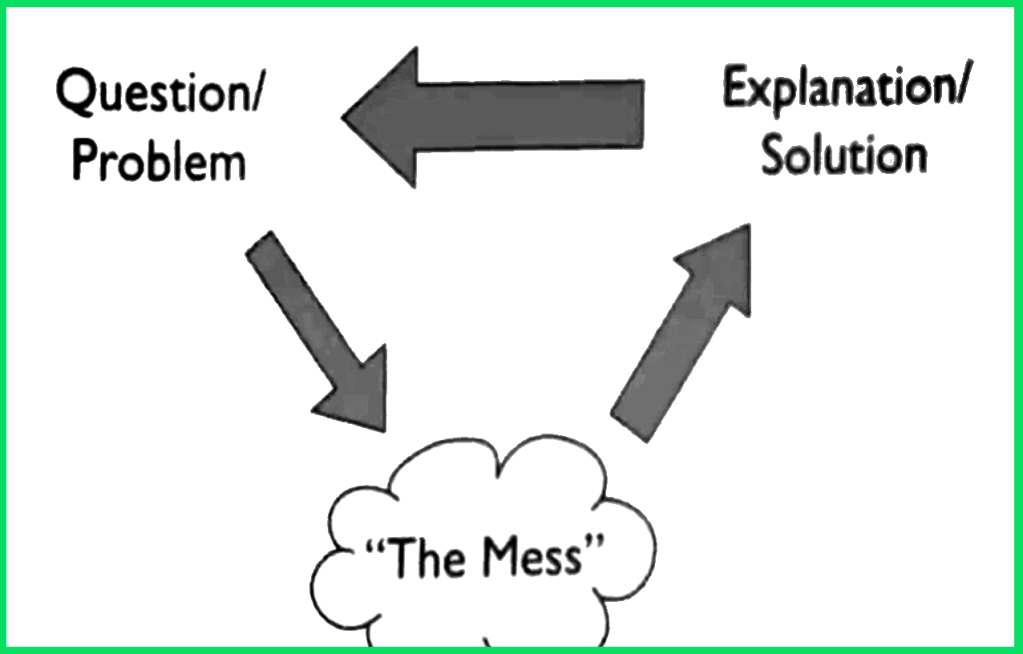
We begin with a question. We follow this question into what the presenter calls “The Mess,” in which we consider its true meaning, all the possibilities, not angling towards a particular solution but exploring, opening ourselves to possibilities. At some point, we gather enough ideas from the Mess to be able to provide an answer.
To me, this sounds an awful lot like writing. In the best writing, we start with something we are curious about and set out to explore. Sometimes we write our way through the mess; sometimes the writing comes after we have our answer, and we seek to communicate our new perspective out to others. If we have really done it, if we have really found a new idea, then others might read it and say, “Oh–I’d never thought of it that way.”
The reading of a text can follow this pattern too. A text that lays its meaning bare may not have the impact of one displaying its mess in full, from which readers draw conclusions and more questions. Perhaps a hybrid form is possible, in which we bring readers into the mess with us, then suggest a conclusion, which the reader may or may not accept.
Good writing is about more than replicating the techniques of other good writers. Although working to add such tools to our toolboxes is necessary, the core of what we do, if it is to push forward our world and our human thought, needs to come from time spent really thinking, living, embracing this mess. This takes time, and not every idea we have works. Sometimes the idea is there, but we lack the tools to lay it out in a way others will understand, or others are not interested. This is hard. But it is worth doing. Of course it is.
I wish you all the best in the coming week. Be well, safe, keep washing your hands, and writing, and being kind. Thanks for stopping by. I would, as ever, love to hear from you.
Jimmy


Leave a comment