Yesterday evening, students gathered together for the annual Poetry Slam event. It isn’t really a poetry slam. It’s something brilliant and beautiful in a different way.
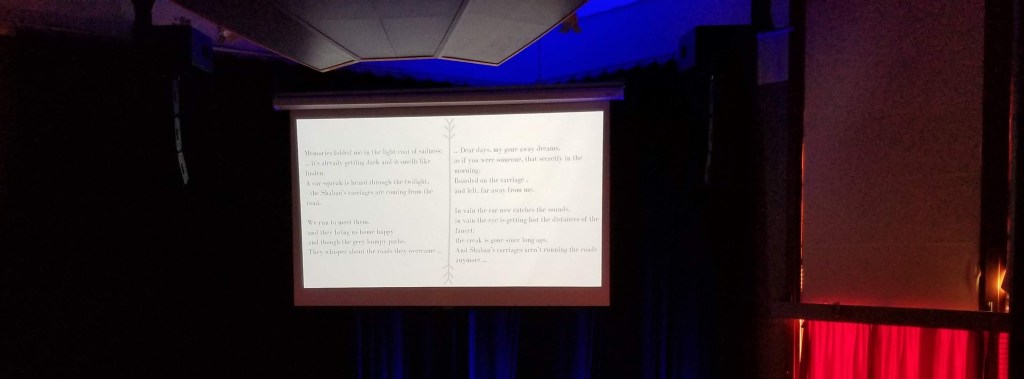
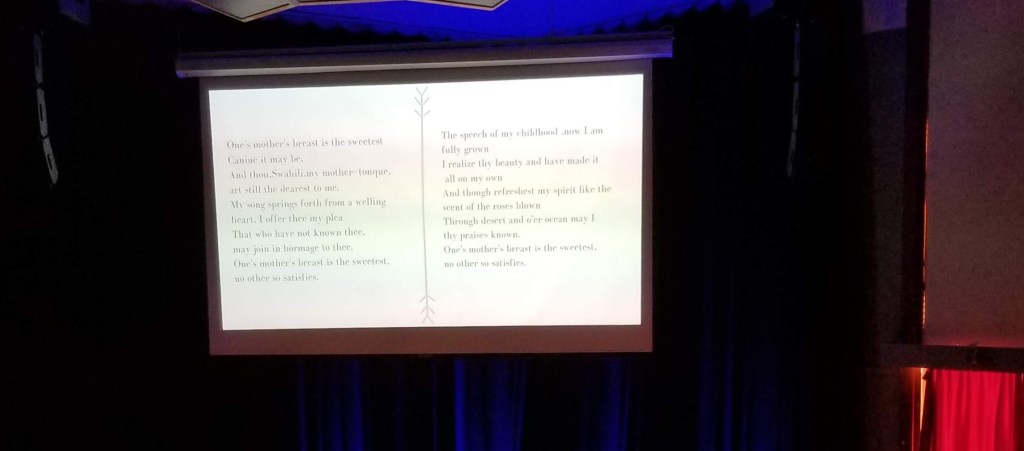
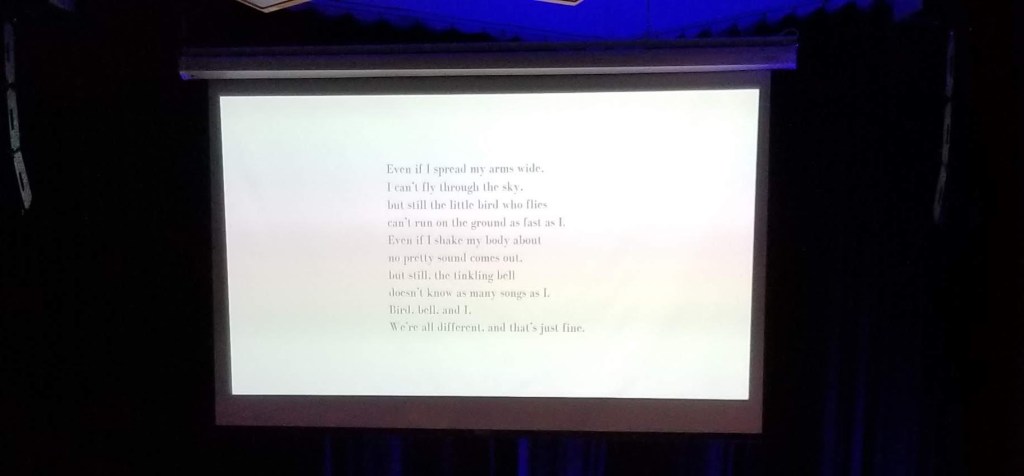
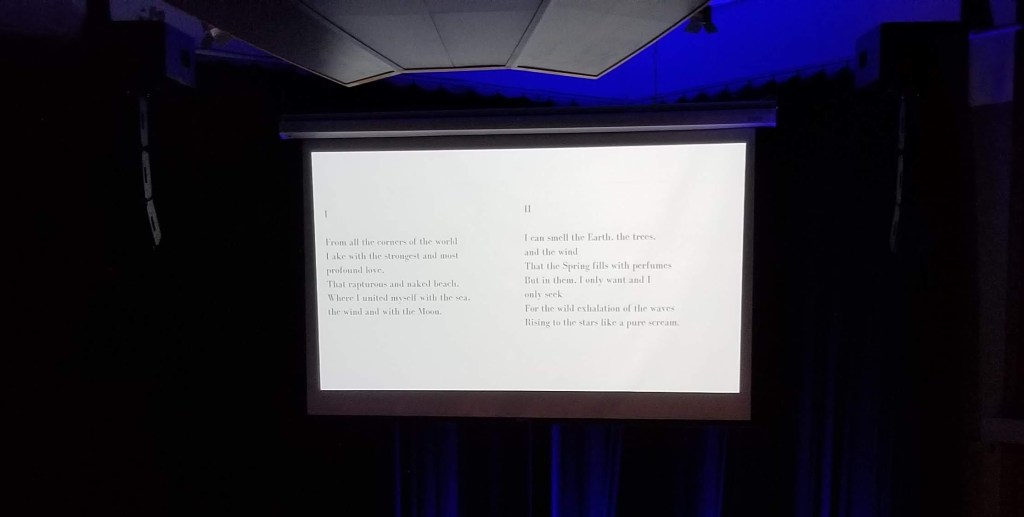
Our students come from about ninety countries, and the vast majority have learned English as an additional language. Unfortunately in an English-medium school, the staggering linguistic diversity of our students sometimes lingers out of sight. But at the poetry slam, students came together to celebrate their languages, presenting poetry in Nepali, Georgian, Macedonian, Cantonese, Icelandic, Norwegian, Portuguese, Indonesian, Timorese, German, Japanese, Hebrew, Arabic, English, Spanish, Kiswahili, Greenlandic, Russian, and others. English translations were projected on the screen above, which I squinted to read, though often I just closed my eyes and listened to the sounds.
In this post today, you’ll be able to squint and read a few poems as well. Perhaps you will find something meaningful.
Each student began with a short explanation–who had written the poem, what it meant to them. Some poems had been written by the students themselves; others were famous poems studied in school; one poem had been written by the student’s mother.
This year, I was struck by something I had not paid much attention to in previous years’ poetry slams: I noticed how many of the poems chosen were some kind of national poem, some kind of cultural heritage that the students wanted to share now with others. Some students mentioned studying this poem in school, hating it, then leaving their country to come to Norway to study and realizing only then what the poem meant.
And this idea of poetry as cultural heritage struck me as so unusual, yet that it should not be unusual, and I thought of the canon of English literature, which is damaging in its raising up of white, male voices at the expense of others, yet sometimes I think the way we have tried to deal with this problem in the English-speaking world has created a different problem altogether. That’s what I hope to explore briefly today.
Literature in American education
I remember distinctly an idea that I was taught in teacher education: You don’t teach The Great Gatsby. You teach reading and literature skills, and The Great Gatsby is your tool.
At the time, this idea was a revelation. I felt it opening up a deeper understanding to me. That our goal was to help students become independent readers, and so we needed to focus on the skills. It was a rhetoric seemingly about empowerment, and the text itself did not matter so much as what skills it could be used to teach. We wrote our learning goals for students always in terms of the skill that would be practiced:
- Students will be able to identify and explain figurative language in a literary text.
- Students will be able to trace character development over the course of a text.
- Students will be able to explain how a thematic idea is expressed in a literary text.
I thought this approach was brilliant, because it disarmed the power of the canon. I can teach diverse texts–I can teach texts by writers of color, writers that students will find engaging, new writers, female writers, queer writers, because the curriculum no longer dictates what texts should be studied–in the Common Core English Language Arts Literature standards for grades 11 and 12, Shakespeare is the only required author.
This is American utilitarianism: that everything studied should be as practical as possible, that yes, we still will study literature (although its place continues to be reduced in the curriculum; “informational texts” are generally expected to make up about fifty percent of English Language Arts study), but we will study it in practical terms, using it as a vehicle to teach reading skills.
And this is American individualism: we have taken so much to heart the the idea of individual choice that there is almost no place for shared literary knowledge. There are very few texts today that we can count on others also having read. Allusion to works of literature becomes ever more esoteric and ivory-towered. And more importantly, the depletion of a shared sense of culture drives deeper the growing polarization in our society.
Skill-based study like this treats literature as an empty vessel whose primary worth is its ability to teach reading skills. It is no longer something deserving study as itself.
I was a firm believer in this idea for a long time. I, who value literature deeply, believed it was about personal meaning. That the great benefit of the skills approach is that in every text we read, there is no prescribed meaning (and that means potentially no shared meaning on which community values can find foothold), and so each student can determine what the text means for themselves. They will find the texts that are meaningful to them and think about them deeply and remember them.
And I do think that this happens. I have seen students fall in love with texts. And I have seen class activities that encouraged personal meaning-making inspire students deeply. Yet I don’t think that’s the whole puzzle. I don’t think it’s enough to ask, “What does this text mean to me?” without taking the time to also understand what it means to others, what it means to different parts of our society, and to wonder if it might mean something to our society as a whole, or humanity as a whole. More than that, I think the idea that simply exposing students to a text without guiding them through how they can find meaning, without insisting there is meaning worth finding and not just a laboratory dissection for the purposes of future independent reading, how much meaning are students not finding that they could?
I think these discussions do sometimes happen in the American English Language Arts classroom, yet I don’t think they are the heart of what we do, because standards keep our focus on the skills. Work that we do with real meaning? That unfortunately is what teachers do because we see that it is important and we fit it in, but we don’t do it particularly well, and we don’t sustain it, and we don’t show students that this is so core to the reason we are here at all.
Last night at the poetry slam, I was sitting with two colleagues, both math teachers, one from Italy, one from Poland. During the intermission, the three of us told stories of our own studies of poetry. “In Poland, you could never read a poem. You had to memorize and then recite it.” Our other colleague agreed. “Every school year, we had to memorize a couple of poems, though today,” he said, “it is becoming less and less.” And there I was, the American, who was not required to memorize a poem until a university creative writing class, and then it was a poem of my choice. I memorized Stanley Kunitz’s “Hornworm: Autumn Lamentation.” I’ve since memorized a number of poems, because I like having a poem in my pocket I can call up in a moment, but I think I am odd. In fifth grade I had to memorize the opening paragraphs of the Declaration of Independence, which I can still recite. My dad told me once about being required to memorize Longfellow’s “The Song of Hiawatha.” We don’t do things like that anymore, for some good reasons, and some less good.
I told these friends with whom I sat, listening to poetry I could not understand, I told them about this tension I see between the teaching of skills through literature, and the teaching of the literature itself. I told them about not teaching The Great Gatsby, just teaching character development. They laughed. “I hated it at the time,” my friend said of the poems she had had to learn, “but now I am glad that I did it. I think everybody needs literature.”
I am not advocating for a return to a prescribed canon. But I am arguing that meaning should be the center again. It matters what the text means, both personal, and shared. No text is neutral. And the reading skills are so important, but they aren’t the main point. They’re there to access the meaning. And of course they are there for the future, when we are lifelong readers, to help us get into the text. But no matter our skills, we won’t be lifelong readers if we don’t show that the thing we study is valuable. That’s where I want to go, as a teacher, as a reader, as a writer.
Thanks for stopping by this week, and best wishes for the week ahead,
Jimmy


